
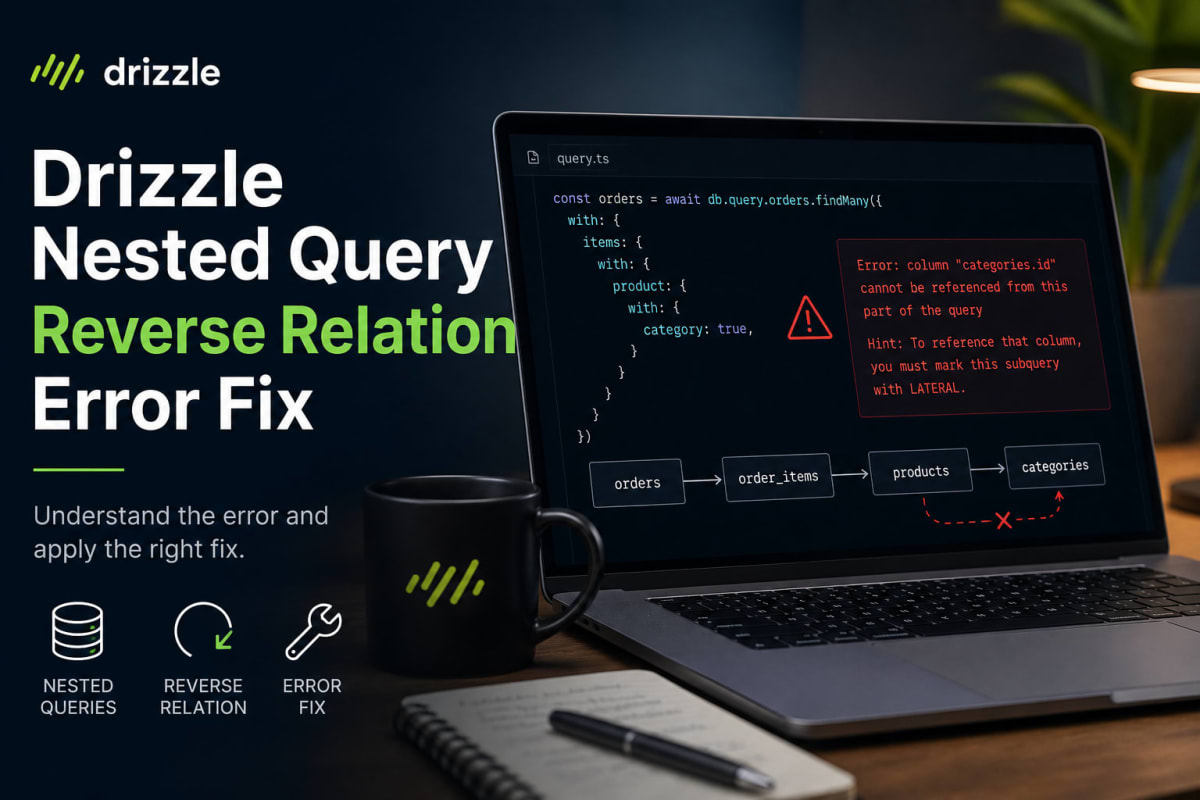
Drizzle Nested Query Reverse Relation Error Fix
Skilldham
Engineering deep-dives for developers who want real understanding.
You're three levels deep into a with clause. Orders, to order items, to products, to category.
It looks just like the docs example.
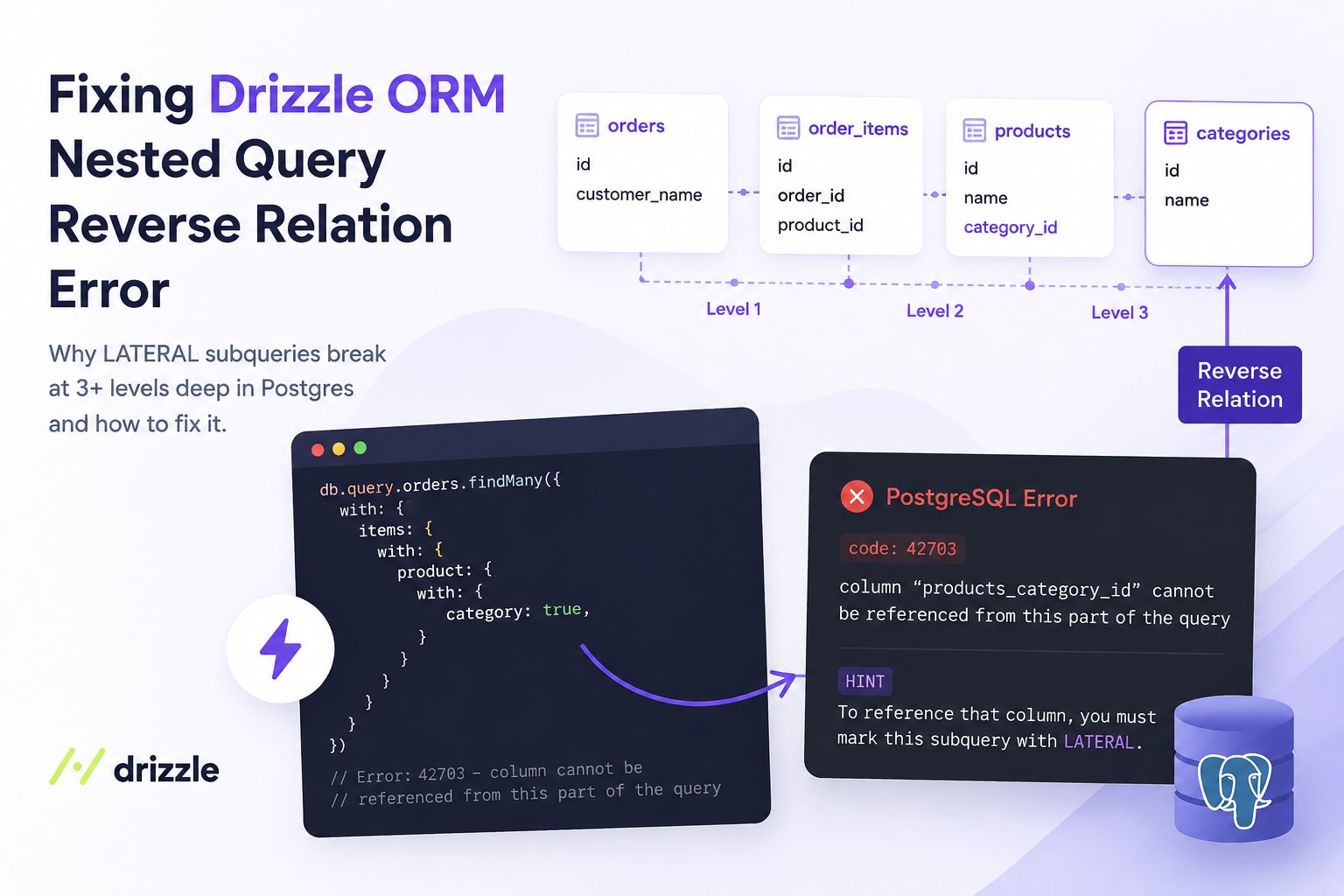
You run it. Postgres throws error code 42703. The message says a column "cannot be referenced from this part of the query." It tells you to mark a subquery with LATERAL.
You didn't write any SQL. You wrote with: { with: { with: {} } }.
This is the drizzle nested query reverse relation problem. It shows up the moment your schema gets realistic.
Quick Answer
The drizzle nested query reverse relation error has one cause. Drizzle builds nested with queries using LEFT JOIN LATERAL subqueries. It adds one per nesting level.
The deepest level here is a reverse relation. Think "product belongs to category." At that point, Drizzle generates a subquery that needs a column. That column lives in a table alias it can't see.
This is a known issue in Drizzle's SQL generation. It's not a mistake in your schema or query syntax. The fix: restructure the query to start from the table that owns the foreign key. Or drop to a raw sql join for that one relation.
Why the Drizzle Nested Query Reverse Relation Error Happens
The error needs three things together:
At least 3 levels of nested with
A reverse relation at the deepest level (the "many" side pointing back to "one")
PostgreSQL, with drizzle-orm 0.31.x or later
Here's a real example from a Drizzle GitHub issue. The query nests like this: projectinternalcost -> projectinternalcostitem -> projecttransactionitems -> projecttransaction. The last hop, projecttransaction, is the reverse relation.
The Postgres error names the exact column:
code: '42703'
detail: 'There is a column named "projecttransaction_id" in table
"project_..._projecttr", but it cannot be referenced from this part
of the query.'
hint: 'To reference that column, you must mark this subquery with LATERAL.'
That long table name is one of Drizzle's auto-generated aliases. Drizzle builds it by joining every table name in the chain.
A Reproducible Example
Here's a smaller schema. It hits the same wall.
typescript
// schema.ts
import { pgTable, serial, text, integer } from "drizzle-orm/pg-core";
import { relations } from "drizzle-orm";

export const categories = pgTable("categories", {
  id: serial("id").primaryKey(),
  name: text("name").notNull(),
});

export const products = pgTable("products", {
  id: serial("id").primaryKey(),
  name: text("name").notNull(),
  categoryId: integer("category_id").references(() => categories.id),
});

export const orderItems = pgTable("order_items", {
  id: serial("id").primaryKey(),
  orderId: integer("order_id").references(() => orders.id),
  productId: integer("product_id").references(() => products.id),
});

export const orders = pgTable("orders", {
  id: serial("id").primaryKey(),
  customerName: text("customer_name").notNull(),
});

export const productsRelations = relations(products, ({ one }) => ({
  category: one(categories, {
    fields: [products.categoryId],
    references: [categories.id],
  }),
}));

export const orderItemsRelations = relations(orderItems, ({ one }) => ({
  order: one(orders, {
    fields: [orderItems.orderId],
    references: [orders.id],
  }),
  product: one(products, {
    fields: [orderItems.productId],
    references: [products.id],
  }),
}));

export const ordersRelations = relations(orders, ({ many }) => ({
  items: many(orderItems),
}));
category on products is a reverse relation. Many products point to one category, through categoryId.
The Failing Query
This query matches the docs pattern exactly.
typescript
// Wrong: throws 42703 / LATERAL error on Postgres
const result = await db.query.orders.findMany({
  with: {
    items: {
      with: {
        product: {
          with: {
            category: true, // reverse relation, 3rd level deep
          },
        },
      },
    },
  },
});
Three levels: orders -> items -> product -> category. The last hop is the reverse one.
What Goes Wrong Under the Hood
Drizzle builds this query as stacked LEFT JOIN LATERAL subqueries. Each nesting level gets its own subquery and its own alias.
The innermost alias is built from the full chain of table names. For our schema, it looks like orders_items_product_category.
That subquery needs to join products to categories. It needs products.category_id = categories.id. But by the time Drizzle builds the category subquery, products.category_id lives one level up. It's in a different subquery's scope.
Postgres has a rule for this. A subquery can't see columns from a sibling or parent scope. Not unless that subquery is marked LATERAL.
Drizzle marks the orders to items join as LATERAL. It marks items to product as LATERAL too. But the final category subquery comes from the reverse relation. It needs products.category_id from the parent scope. The right LATERAL marker never reaches that deep.
That's the mismatch. The Postgres hint is technically correct. It's describing a join Drizzle needs to add - not something you can fix from the query builder API.
Two Working Fixes
Fix 1: Start From the "Many" Side
Don't start from orders and nest down to category. Start from products instead. That's the table that owns categoryId.
typescript
// Correct: query from products, the table with the foreign key
const productsWithCategory = await db.query.products.findMany({
  with: {
    category: true,
  },
});
This works for one reason. category is now the first level of nesting, not the third. The category subquery only needs products.category_id. That column is in scope at this level. No LATERAL conflict.
Now run your orders -> items -> product query on its own. Drop the reverse hop:
typescript
const ordersWithItems = await db.query.orders.findMany({
  with: {
    items: {
      with: {
        product: true, // stop here, no reverse relation
      },
    },
  },
});
Merge productsWithCategory into ordersWithItems in your application code. Key it by product.id. For most order-list pages, that's two fast indexed queries. Better than one query that can't run at all.
Fix 2: Raw Join for the Problem Relation
Need everything in one round trip? Drop the reverse relation from with. Join it manually with Drizzle's query builder.
typescript
// Correct: manual join for the reverse relation, query builder for the rest
import { eq } from "drizzle-orm";

const ordersWithItems = await db.query.orders.findMany({
  with: {
    items: {
      with: {
        product: true,
      },
    },
  },
});

const categoryIds = ordersWithItems
  .flatMap((o) => o.items.map((i) => i.product?.categoryId))
  .filter((id): id is number => id != null);

const categoryRows = await db
  .select()
  .from(categories)
  .where(
    categoryIds.length > 0
      ? eq(categories.id, categoryIds[0])
      : undefined
  );
Got more than a handful of category IDs? Swap eq for inArray from drizzle-orm. This category lookup is a flat, single-table query. No nesting, no LATERAL. Map the results back onto product.category in your application code.
Both fixes avoid the same failure pattern. Three-plus levels of with, with a reverse relation at the bottom.
Which Versions Show This
This was reported against drizzle-orm 0.31.2. It persists into later 0.3x releases on the original relational query engine - sometimes called RQB v1.
Drizzle has since shipped Relational Queries v2. It uses a separate relations.ts file and a defineRelations API. It's a broader rework of the relational layer.
The underlying issue remains open as of this writing. On RQB v1, assume the LATERAL error is still possible on deep reverse-relation nesting. Confirm on your installed version.
Starting a new project? Check whether RQB v2 fixes this pattern first. Do that before you commit to deep nested reverse relations in your schema.
Key Takeaways
The drizzle nested query reverse relation error (42703 with a LATERAL hint) happens at 3+ levels of with when the final level is a many-to-one relation
Drizzle generates one LEFT JOIN LATERAL subquery per nesting level - the error means a column reference can't cross subquery scopes at the deepest level
This is a known SQL generation limitation, not a schema or syntax mistake on your part
Fix 1: query from the table that owns the foreign key first, then merge results in application code
Fix 2: keep the rest of your nested query as-is, but fetch the reverse relation with a separate flat query and an inArray lookup
Reverse relations work fine at the first level of with - the problem is specifically about depth plus position
Check your Drizzle version and consider RQB v2 if you're starting fresh with schemas that need this pattern often
FAQs
Why does Drizzle throw a LATERAL error on a nested relational query?
Drizzle builds nested with queries as stacked LEFT JOIN LATERAL subqueries, one per level. When the deepest level is a reverse many-to-one relation, the generated subquery needs a column from an outer scope. Postgres rejects it with a 42703 error.
Is this a bug in my schema or my query syntax?
No. Your query matches Drizzle's documented with syntax exactly. The issue is in how Drizzle generates SQL for this depth and direction combination.
Does this happen with one-level with queries too?
No. A single-level with works fine, even on a reverse relation. The error appears at 3+ levels, when the last level is reverse.
What's the fastest fix if I just need this working today?
Restructure the query to start from the table that owns the foreign key. That's Fix 1. It's two simple queries, merged in code. It avoids the LATERAL pattern entirely.
Will switching to Relational Queries v2 fix this?
RQB v2 uses a separate defineRelations config to define relations. But verify this deep-nesting case against your own schema first. The original issue was filed against v1, and its status on v2 isn't confirmed here.
Does this affect MySQL or SQLite too?
The error message itself is Postgres-specific - LATERAL is a Postgres and SQL-standard construct. A related issue shows TiDB also fails on Drizzle's generated LEFT JOIN LATERAL queries, since TiDB doesn't support LATERAL joins at all. Other databases can hit different errors from the same root cause.
Can I avoid this by not using the relational query API?
Yes. Drizzle's standard query builder - .select().from().leftJoin() - gives you full control over joins. It never generates LATERAL subqueries on its own. A hybrid approach works well: relational API for shallow reads, manual joins for deep ones.
Is there an open GitHub issue I can follow for this?
Yes. The original report describes this exact pattern - a deeply nested query ending in a reverse relation. It's tracked on the drizzle-orm GitHub repository under bug reports.
Conclusion
The LATERAL error isn't telling you to fix your schema. It's surfacing a gap in how Drizzle's relational query engine handles deep reverse relations.
Once you know the rule, you can design around it. Reverse relations are safe at the top level. They get risky three levels down.
Working through more Drizzle and Postgres edge cases? The next post in this series covers when to use manual joins instead of the relational with API.