
Mongoose Buffering Timed Out? Not Your URI or IP
Skilldham
Engineering deep-dives for developers who want real understanding.
Last updated: July 2026
TL;DR
Mongoose buffering timed out in production is rarely about your URI or IP whitelist. It happens when a serverless function opens a new Mongoose connection on every request instead of reusing one. Mongoose 8 checks connection state more strictly than Mongoose 7. Old code that "sort of worked" now fails on and off. The fix is a cached connection at module scope, not a longer timeout.
You write the query. It works on your machine.
It works in staging too.
Then production throws this error:
MongooseError: Operation users.findOne() buffering timed out after 10000ms
Not every time. Just sometimes. Usually right after traffic picks up.
You check the URI. It's correct.
You check the IP whitelist on Atlas. Your host's IP range is already there.
You redeploy. It works for an hour. Then it fails again.
You just spent a night chasing the wrong thing. The real problem is how your code opens the connection. And Mongoose 8 stopped forgiving the old way of doing it.
The Five Generic Fixes Everyone Gives You First
What these fixes actually solve
Search "mongoose buffering timed out." You get the same five answers everywhere.
Bad connection string. IP not whitelisted on Atlas. Mongoose imported before connect() runs. Database name typo. Network blocked by a firewall.
These are real causes. They are also the only causes most articles cover.
Why they don't explain your case
None of these explain one specific pattern. The code is identical. It passes locally. It passes in staging. It only fails in production. And it only started after you upgraded from Mongoose 7 to Mongoose 8.
If you're setting up MongoDB in a Next.js app for the first time, the MongoDB and Resend setup for Next.js post covers the initial connection code. This post picks up where that one leaves off, once that setup starts failing under real traffic.
A bad URI fails every time, everywhere. A blocked IP never connects at all. Your bug is different. It comes and goes. That points somewhere else.
The Pattern Nobody Explains - Production-Only, Post-Upgrade
The exact symptom developers report
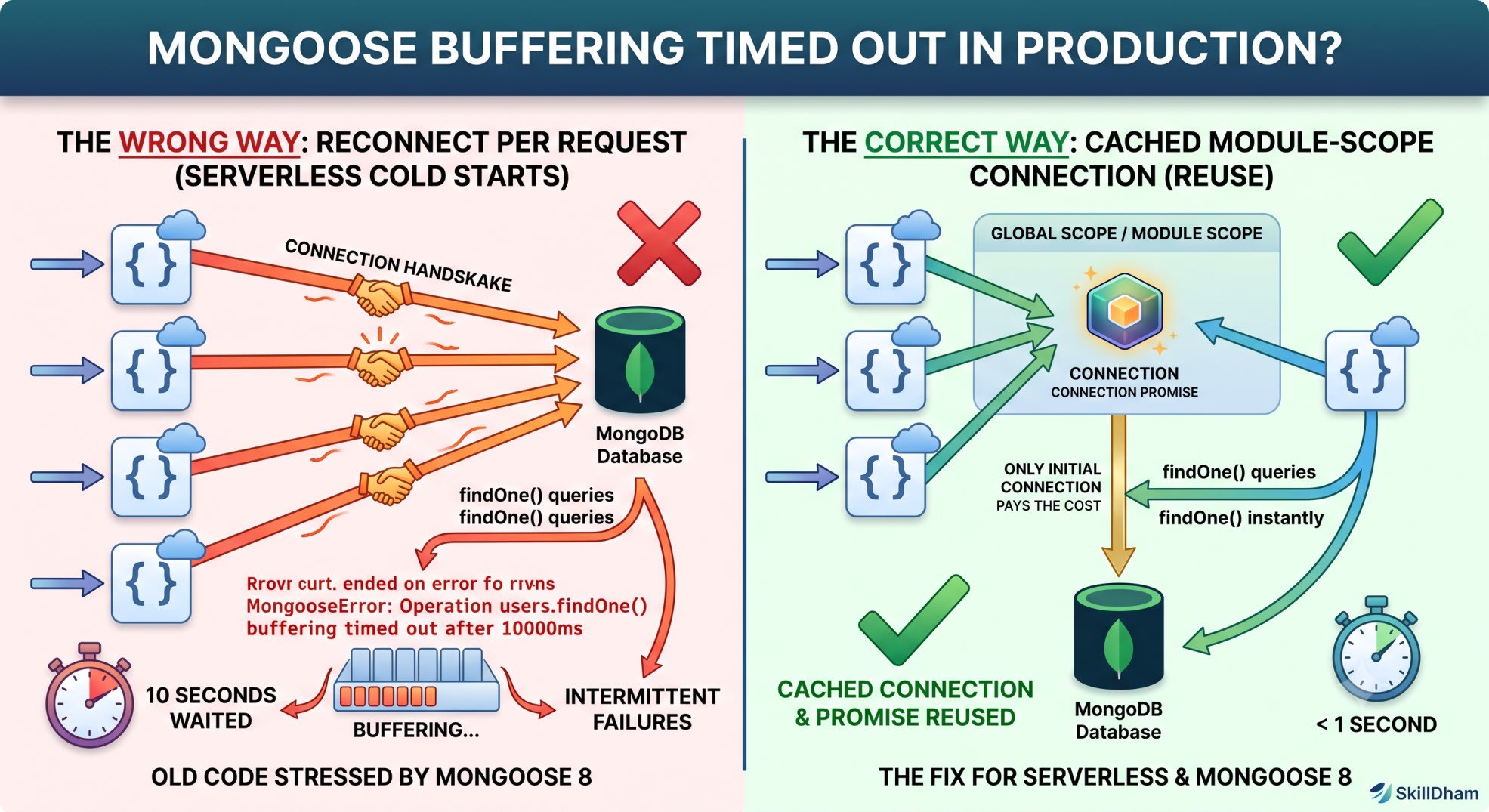
Here's the shape of the bug. A Next.js API route calls mongoose.connect() inside the request handler. Not outside it, inside it.
On a normal server, this runs once. The connection stays open for the app's whole life.
On a serverless host, it's different. Each request can spin up a fresh environment. That environment has no memory of the last one.
What happens next
Some requests land on a warm environment. They reuse an open connection. They succeed instantly.
Other requests land on a cold one. They try to open a new connection. The query fires before that connection is ready.
Mongoose queues the query in a buffer. It waits. After 10 seconds, it gives up and throws.
What ties Mongoose 7, Mongoose 8, and serverless together
I hit this on Munshi's API routes after moving from Mongoose 7 to Mongoose 8. The connection code hadn't changed. The failure rate had.
Mongoose 8 tightened its internal connection checks. Mongoose 7 used to quietly reuse a half-open connection. Mongoose 8 catches that instead and throws.
This isn't a regression. It's Mongoose being stricter about a mistake that was already in your code. You just got away with it before.
The Wrong Code - Connecting Inside the Request Handler
Wrong code block
javascript
// Wrong: connects on every single invocation
import mongoose from "mongoose";
import { NextResponse } from "next/server";

export async function GET() {
  await mongoose.connect(process.env.MONGODB_URI);

  const users = await mongoose.model("User").find();
  return NextResponse.json(users);
}
What breaks and why
This works the first time. A serverless instance starts up. Mongoose connects. The query runs.
The problem shows up on the next cold start. A fresh instance has no open connection. It calls connect() again.
That connection takes time to negotiate with MongoDB. But your find() call doesn't wait for it. It fires right away.
Mongoose queues the query. This is the buffer. If the connection finishes in time, the query runs late but still works.
If it doesn't finish in time, Mongoose throws. The default wait is bufferTimeoutMS, set to 10 seconds. Under real traffic, with cold starts hitting in parallel, this becomes the "works sometimes" pattern you're seeing.
The Fix - Cache the Connection at Module Scope
Correct code block
javascript
// Correct: connection is cached once and reused across invocations
import mongoose from "mongoose";

let cached = global._mongooseConnection;

if (!cached) {
  cached = global._mongooseConnection = { conn: null, promise: null };
}

export async function getDb() {
  if (cached.conn) {
    return cached.conn;
  }

  if (!cached.promise) {
    cached.promise = mongoose.connect(process.env.MONGODB_URI, {
      bufferCommands: true,
      maxPoolSize: 10,
    });
  }

  cached.conn = await cached.promise;
  return cached.conn;
}
javascript
// Correct: the route awaits the cached connection before querying
import { NextResponse } from "next/server";
import { getDb } from "@/lib/db";
import mongoose from "mongoose";

export async function GET() {
  await getDb();

  const users = await mongoose.model("User").find();
  return NextResponse.json(users);
}
Why this works with serverless cold starts
The global._mongooseConnection object survives between requests on a warm instance. It doesn't reset each time.
The first request pays the connection cost. Every request after that reuses the same connection. No new handshake. No new wait.
Mongoose's own FAQ backs this up. Open the connection once, when the app starts. Leave it open until shutdown. Don't open a new one per operation.
Serverless makes that rule easy to break by accident. Every route file can look like a fresh app start. It isn't one.
The same problem shows up with SQL connections on serverless hosts too, not just MongoDB. The Prisma driver adapter setup for Next.js and NeonDB covers the same connection-reuse pattern from the SQL side, if you're running both in the same app.
Why the promise field matters too
The promise field does real work here. Without it, two requests can hit a cold instance at the same time.
Both try to connect. Both start their own handshake. You end up with two connections instead of one.
Caching the promise, not just the finished connection, closes that gap. The second request waits on the first one's promise instead of starting its own.
What Changed in Mongoose 8's Connection Handling
bufferCommands and bufferTimeoutMS
bufferCommands defaults to true in both Mongoose 7 and Mongoose 8. When it's on, an early query gets queued instead of failing right away.
bufferTimeoutMS sets how long that queue waits. The default is 10000, or 10 seconds. This default hasn't changed between versions.
What actually changed
The defaults are the same. What changed is detection.
Mongoose 8 checks connection state more carefully. Mongoose 7 sometimes treated a half-open connection as good enough. Mongoose 8 does not.
Code that connected per request and got lucky under Mongoose 7 now hits the buffering timeout more often. The upgrade didn't create the bug. It removed the safety net that was hiding it.
If you need queries to fail fast instead
You can lower bufferTimeoutMS. You can also set bufferCommands to false globally.
Both options turn a 10-second hang into an instant error. Neither one fixes the root cause. The cached connection does.
How to Confirm This Is Your Bug
Check connection reuse across requests
Log mongoose.connection.readyState at the top of your route handler. Check your platform's function logs.
A value of 0 means disconnected. A value of 2 means still connecting. If you see either one right before a timeout, and it's not every request, you're reconnecting per invocation.
Watch for this timing pattern
Failures often cluster right after a deploy. They also cluster after a quiet period, when your host has scaled down to zero.
Both moments force a cold start. Every cold start is a fresh chance to hit this bug.
The open GitHub issue as evidence
This exact pattern has its own open issue on the Mongoose GitHub repo (Automattic/mongoose #14971). Identical code. Passes locally. Fails on and off in production, after a Mongoose 7 to 8 upgrade, on a serverless host.
It's still tagged for investigation, months after it was filed. Older issues describe the same root shape on other serverless platforms, years apart.
That's worth knowing before you spend a night assuming you misconfigured something. This pattern is structural. It's tied to how serverless hosts recycle environments, not to a mistake unique to your codebase.
Key Takeaways
Mongoose buffering timed out in production, but not locally, is rarely a bad URI or IP whitelist issue.
The real cause is usually a new mongoose.connect() call on every serverless invocation, instead of one cached connection.
Mongoose 8 checks connection state more strictly than Mongoose 7, so old code fails more often after the upgrade.
bufferTimeoutMS defaults to 10 seconds. Lowering it hides the symptom. It does not fix the cause.
Cache the connection at module scope, using global._mongooseConnection, so warm instances reuse it.
Cache the connection promise too, not just the resolved connection. This stops two cold requests from racing.
This is a known, structural pattern on serverless hosts. There's an open Mongoose GitHub issue for it. It is not user error.
FAQ
Is mongoose buffering timed out always caused by a bad connection string?
No. A bad connection string fails every request, in every environment. If the error only shows up in production, and only sometimes, the cause is usually how you're opening the connection. It's rarely the string itself.
Why does this error only happen in production, not in dev or staging?
Locally, you run one long-lived Node process. The connection opens once and stays open. Production serverless hosts spin environments up and down. Code that connects inside the request handler reconnects far more often there.
Does upgrading from Mongoose 7 to Mongoose 8 cause this on its own?
Not by itself. The upgrade makes Mongoose stricter about detecting a connection that isn't ready yet. If your code already reconnected per request, Mongoose 8 just surfaces that mistake more often than Mongoose 7 did.
Can I just increase bufferTimeoutMS to fix it?
You can. It will reduce how often you see the error. But it only gives cold connections more time to finish. It doesn't stop your code from opening a new connection on every request. The underlying cost stays the same.
Does this happen on AWS Lambda too, or only Vercel and Amplify?
It happens on any host that recycles execution environments, including AWS Lambda. It shows up most with change streams or long-lived listeners that don't survive a cold start. The trigger differs by platform. The root cause, reconnecting instead of reusing, stays the same.
What is the module-scope caching pattern and why does it fix this?
It stores the connection, and the in-flight connection promise, on a variable that survives between requests on a warm instance. Requests after the first one reuse that connection instead of paying the connection cost again.
Is this a known bug in Mongoose, or is it user error?
It sits in between. Mongoose is behaving correctly by enforcing its buffering rules more strictly in version 8. The open GitHub issue exists because the failure mode is confusing and under-documented, not because Mongoose is broken.
Does connecting inside every API route always cause buffering timeouts?
Not always. On a warm instance with low traffic, it may go unnoticed. Under real production load, with cold starts happening often, it becomes far more likely to show up as a timeout.
Conclusion
Mongoose buffering timed out in production is a connection-reuse problem. It just wears a connection-string costume. Mongoose 8 didn't break your app. It stopped hiding a per-invocation connection pattern that never scaled. Cache the connection at module scope, and the "intermittent" timeouts stop being intermittent.
Running Mongoose on Vercel, Amplify, or Lambda? Check your connection setup first. Do that before you touch your URI or your Atlas IP whitelist again. Subscribe to the SkillDham newsletter for more production-only bugs we've actually hit and fixed, not the generic checklist version.