
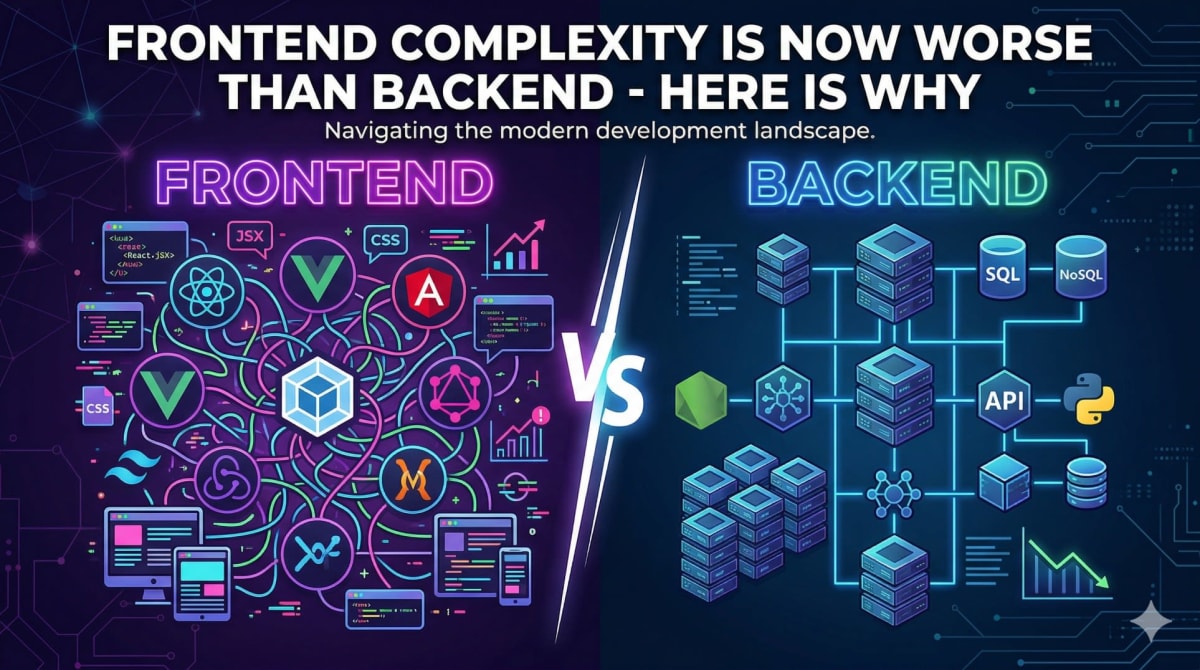
Frontend Complexity Is Now Worse Than Backend - Here Is Why
Skilldham
Engineering deep-dives for developers who want real understanding.
There was a time when the split was clear. Backend developers handled the hard stuff - databases, business logic, security, scaling. Frontend developers built the UI that sat on top. It was a reasonable division. Backend was where the architecture lived. Frontend was where the pixels lived.
That division no longer reflects reality. Frontend complexity has quietly overtaken backend complexity in most modern products.
In most modern products, frontend complexity has quietly overtaken backend complexity. The teams building these products often have not fully acknowledged this shift - which is why so many frontend codebases become painful to work in after twelve months, even when they started clean.
This is not a complaint about frameworks or a call for simpler tools. It is an honest look at what frontend development actually involves now and why treating it as "just UI" consistently produces systems that are hard to maintain, hard to debug, and slow to change.
What Frontend Complexity Actually Looks Like Now
The mental model that frontend is presentation and backend is logic stopped being accurate years ago. What a modern frontend application owns is closer to this:
State management for data that changes in real time. Data fetching with caching, background refetching, and cache invalidation. Role-based UI that shows different things to different users based on permissions. Feature flags that change what is visible without a deployment. Performance optimization that directly affects user retention. Accessibility that determines whether the product is legally usable. SEO that determines whether the product is discoverable. Server-side rendering with hydration that requires understanding both client and server execution contexts. Error boundaries that determine how gracefully the application fails. Analytics instrumentation that affects every user interaction.
That list is not "UI plus some extra stuff." That is a system with real complexity, real failure modes, and real architectural decisions that compound over time.
Backend, in the same period, went the other direction. Cloud services absorbed infrastructure. Frameworks standardized patterns. Managed databases removed operational complexity. Serverless removed deployment complexity. The scope narrowed and the tools matured.
Frontend scope expanded. The tools matured. But the mental model - "frontend is the easy part" - did not update with either of them.

Frontend Now Owns Business Logic Whether Teams Admit It or Not
This is the specific shift that causes the most damage when it goes unacknowledged.
In a typical production application, the frontend decides what users can see based on their role. It decides which actions are available based on their subscription tier. It validates whether a workflow is in a valid state before allowing progression. It enforces rules about what can be modified and under what conditions.
That is business logic. Not presentation logic. Not UI logic. Business logic - the rules that define how the product works.
jsx
// This looks like UI code
function OrderActions({ order, user }) {
  return (
    <div>
      {user.role === 'admin' && <CancelButton order={order} />}
      {order.status === 'pending' && user.permissions.includes('approve') && (
        <ApproveButton order={order} />
      )}
      {order.total > 10000 && !order.managerApproved && (
        <RequestApprovalButton order={order} />
      )}
    </div>
  );
}
This component contains business rules - who can cancel, who can approve, when escalation is required. These rules live in the frontend because that is where they need to be enforced for the UI to make sense. But they are business rules. If they change, product behaviour changes.
The problem is not that this logic exists in the frontend. The problem is when it is scattered across dozens of components with no clear ownership, no tests, and no documentation - because the team treated it as "just rendering conditions" rather than business rules that deserve the same care as backend logic.
jsx
// Better - business logic extracted and explicit
function useOrderPermissions(order, user) {
  return {
    canCancel: user.role === 'admin',
    canApprove: order.status === 'pending' && user.permissions.includes('approve'),
    requiresManagerApproval: order.total > 10000 && !order.managerApproved,
  };
}

function OrderActions({ order, user }) {
  const permissions = useOrderPermissions(order, user);

  return (
    <div>
      {permissions.canCancel && <CancelButton order={order} />}
      {permissions.canApprove && <ApproveButton order={order} />}
      {permissions.requiresManagerApproval && <RequestApprovalButton order={order} />}
    </div>
  );
}
Same logic. Now it has a name, a location, and can be tested independently. This is what treating frontend as a system looks like rather than treating it as presentation.
The Complexity Is Invisible Until It Is Not
Frontend complexity has a specific property that makes it particularly damaging: it does not hurt immediately. A new React codebase is usually clean. Components are focused. State is manageable. The team moves fast and things work.
The pain starts around month six to twelve. By that point, the codebase has features that nobody fully understands anymore. Changing one component breaks something on a different page. Performance issues appear after small changes. New developers take weeks to become productive. The team starts adding tickets for "tech debt" without a clear plan for what that means.
This is the cost of unacknowledged frontend complexity. Not a dramatic failure - a slow accumulation of friction that compounds month over month.
Backend teams with similar levels of complexity tend to invest in architecture earlier - domain boundaries, service boundaries, database design, API contracts. These investments pay off over time. Frontend teams often do not make equivalent investments until the pain forces the conversation.
Our guide on why React apps feel slow even when APIs are fast covers one specific version of this - performance complexity that accumulates silently and only becomes visible at production scale.
Why Frontend Complexity Is Harder to Manage Than Backend
Backend complexity tends to be isolatable. A database query is slow - you can find it, measure it, and fix it. A service is failing - the logs tell you where. Business logic is wrong - there are tests that define what correct looks like.
Frontend complexity resists isolation in ways backend does not.
State is distributed across components, hooks, context, and external stores. A bug might be caused by a component three levels up in the tree setting state that a component three levels down reads through context. The path between cause and effect is not visible from either end.
Rendering behaviour depends on the order and timing of state updates, which depends on how React's scheduler prioritizes work, which is not straightforward to reason about without deep framework knowledge. A change that looks safe can produce a cascade of re-renders that affects performance in a completely different part of the application.
Browser behaviour adds another layer. The same code behaves differently in different browsers, at different screen sizes, with different accessibility settings enabled, on devices with different performance characteristics.
jsx
// This seems fine
function Dashboard({ userId }) {
  const { data: user } = useQuery(['user', userId], fetchUser);
  const { data: stats } = useQuery(['stats', userId], fetchStats);
  const { data: notifications } = useQuery(['notifications'], fetchNotifications);

  // But if any of these queries refetch at different times,
  // the UI can show inconsistent states - user loaded but stats not yet,
  // or notifications from a different user session
}
Managing this kind of temporal complexity - multiple async operations that need to present a coherent UI - requires explicit thought about loading states, error states, and the transitions between them. Backend code has equivalent complexity in distributed systems, but the tooling for reasoning about it is more mature.
What Teams Get Wrong About Frontend Architecture
The most common frontend architecture mistake is treating it as something you figure out as you go rather than something you design deliberately.
Backend teams routinely make upfront decisions about database schemas, API contracts, service boundaries, and authentication flows. These decisions are understood to be hard to change later, so they get design time.
Frontend teams often make equivalent decisions informally, in the middle of feature development, without realizing that those decisions will be just as hard to change. Where does state live? Who owns this data? What happens when this API call fails? These questions get answered with whatever is convenient in the moment.
The specific decisions that matter most for long-term frontend health are where state lives and what owns it, how server state is separated from client state, what the component tree looks like at the feature level rather than the component level, and how business logic is isolated from rendering logic.
Our post on React state not updating covers one specific version of this - how state ownership decisions cause bugs that look like React problems but are actually architecture problems.
The React documentation on thinking in React is worth reading with this frame in mind - the questions it asks about state ownership are the same architectural questions that determine whether a frontend codebase stays maintainable at scale.
Key Takeaway
Frontend complexity has not grown because frameworks got complicated or developers got lazy. It grew because products put more of their core behaviour in the frontend - closer to users, more responsive, more real-time, more personalised. That is a legitimate product requirement. The problem is when teams do not update their engineering practices to match.
Treating frontend as a system - with deliberate state design, explicit business logic ownership, and architectural decisions made at the right time - produces codebases that stay manageable as they grow. Treating it as presentation with some hooks attached produces codebases that become painful to work in by the time they matter most.
Frontend complexity is real. The question is whether teams acknowledge it early enough to do something about it.
FAQs
Is frontend really more complex than backend in modern apps? In many cases, yes - not because backend became simpler in absolute terms, but because backend complexity was absorbed by cloud services, managed databases, and standardized frameworks, while frontend scope expanded to include state management, caching, permissions, performance, accessibility, and server-side rendering. The responsibilities shifted even if the perception did not.
What causes frontend complexity to grow so fast? Product requirements push complexity toward the user interface because that is where user experience lives. Real-time updates, personalisation, role-based features, offline capability, and performance requirements all land in the frontend. Each one is manageable individually. Together, and without deliberate architecture, they compound into systems that are hard to reason about.
Why does frontend complexity hurt teams more than backend complexity? Frontend complexity is harder to isolate. State is distributed across components and contexts with non-obvious connections. Rendering behaviour depends on timing and scheduler decisions. Browser differences add variation. The path between a cause and its visible effect is often long and indirect, which makes debugging slower and refactoring riskier than equivalent backend changes.
Does switching to a different framework reduce frontend complexity? Almost never. The complexity comes from the product requirements, not the framework. A team that migrates from React to Svelte or from Next.js to Remix brings the same state design problems, the same business logic distribution problems, and the same performance problems to the new framework. The framework changes. The underlying complexity does not.
How should teams start addressing frontend complexity? By treating frontend as a system rather than a layer. This means making explicit decisions about where state lives and who owns it, separating business logic from rendering logic, separating server state from client state, and investing in frontend architecture at the beginning of features rather than cleaning up at the end. The same disciplines backend teams apply to database design and service boundaries apply to frontend architecture.