
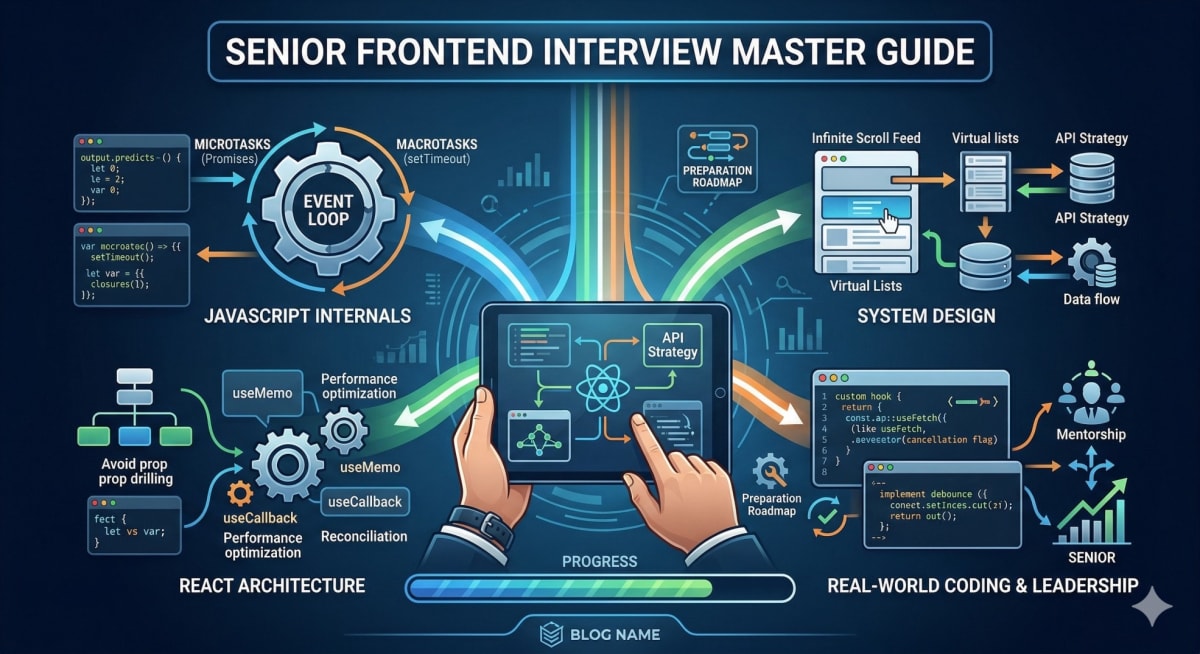
Senior Frontend Interview Preparation Guide
Skilldham
Engineering deep-dives for developers who want real understanding.
You have been coding for years. You know React. You can build things. But you keep hitting a wall in senior frontend interviews - and you are not sure exactly what they are looking for that you are not giving them.
Here is what changes at the senior level: companies stop testing whether you can use tools and start testing whether you understand why the tools work the way they do. Senior frontend interview preparation is less about memorizing APIs and more about being able to reason clearly about tradeoffs, architecture, and system behavior.
This guide covers exactly what gets tested, how to think about each area, and what good answers actually look like - not just lists of topics, but the depth level that gets you hired.
JavaScript Internals Are Tested Differently at Senior Level
At junior and mid levels, JavaScript questions test syntax and basic concepts. At senior level, they test your mental model of how the language actually executes.
The event loop is the most common deep-dive topic. Interviewers do not want you to recite the definition - they want to see if you can predict execution order when promises, setTimeout, and synchronous code are mixed together.
Classic output question:
js
console.log('1');

setTimeout(() => console.log('2'), 0);

Promise.resolve().then(() => console.log('3'));

console.log('4');

// Output: 1, 4, 3, 2
// Why: sync code first, then microtasks (promises), then macrotasks (setTimeout)
If you cannot explain why 3 comes before 2 even though both are asynchronous, that is a gap worth closing before your next interview. The answer is that promises go into the microtask queue, which is drained completely before the macrotask queue (where setTimeout lives) gets a turn.
Closure question that trips people up:
js
for (var i = 0; i < 3; i++) {
  setTimeout(() => console.log(i), 0);
}
// Output: 3, 3, 3 - not 0, 1, 2

// Fix with let:
for (let i = 0; i < 3; i++) {
  setTimeout(() => console.log(i), 0);
}
// Output: 0, 1, 2
Senior frontend interview preparation for JavaScript means understanding closures, scope, the event loop, prototype chain, and async execution at a level where you can predict behavior - not just recognize it.
For a deeper look at how JavaScript handles asynchronous operations, our guide on JavaScript promise not working covers the most common mistakes developers make with promises and how to fix them.
React Architecture Is What Separates Mid from Senior
React hook questions are mid-level. What seniors get asked is architecture - how do you structure things so they scale, stay maintainable, and perform well as the codebase grows.
The most common React architecture question is: how do you avoid prop drilling without reaching for a global state manager? The expected answer demonstrates knowledge of component composition, not just Context API.
Composition pattern - often a better answer than context:
jsx
// Instead of passing props through multiple levels:
function App() {
  const [user, setUser] = useState(null);
  return <Dashboard user={user} />; // passes user down
}

function Dashboard({ user }) {
  return <Sidebar user={user} />; // just passing through
}

function Sidebar({ user }) {
  return <UserCard user={user} />; // finally used here
}

// Better - use composition:
function App() {
  const [user, setUser] = useState(null);
  return (
    <Dashboard>
      <Sidebar>
        <UserCard user={user} /> {/* user passed directly where needed */}
      </Sidebar>
    </Dashboard>
  );
}
The other area that gets tested heavily is performance optimization. Specifically - when should you use useMemo and useCallback, and when are they actually making things worse?
jsx
// Wrong - useMemo on a cheap calculation adds overhead
const value = useMemo(() => a + b, [a, b]); // unnecessary

// Right - useMemo on an expensive calculation or referential equality
const filteredList = useMemo(
  () => largeList.filter(item => item.active), // expensive
  [largeList]
);

// Right - useCallback when passing to a memoized child
const handleClick = useCallback(() => {
  onUpdate(id);
}, [id, onUpdate]);
```

The senior answer on memoization is not "always use it" - it is "profile first, optimize where you see actual rerenders causing performance issues." Companies want engineers who understand tradeoffs, not engineers who apply patterns blindly.

---

## Frontend System Design Is the Real Differentiator

This is where most candidates who have good JavaScript and React knowledge still get filtered out. Senior frontend interview preparation must include system design - and it is a skill that has to be practiced separately.

Frontend system design questions are not about databases and load balancers. They are about component architecture, data flow, API strategy, state management decisions, caching, and performance at scale.

A typical question: design an infinite scrolling news feed.

A mid-level answer describes the UI components and mentions an API call.

A senior answer covers:

**Component architecture:**
```
FeedContainer (manages data fetching + pagination state)
  FeedList (renders items, triggers load more)
    FeedItem (single post - memoized)
  LoadingIndicator
  ErrorBoundary
Pagination strategy:
js
// Cursor-based pagination - better for feeds that update frequently
const { data, fetchNextPage } = useInfiniteQuery({
  queryKey: ['feed'],
  queryFn: ({ pageParam = null }) =>
    fetchPosts({ cursor: pageParam, limit: 20 }),
  getNextPageParam: (lastPage) => lastPage.nextCursor,
});
Performance considerations:
Virtual scrolling for large lists using react-window - only render visible items
Image lazy loading - loading="lazy" or Intersection Observer
Stale-while-revalidate caching - show cached data immediately, refresh in background
Debounce scroll events to avoid excessive API calls
Error and loading states:
jsx
function Feed() {
  if (isLoading) return <FeedSkeleton />;
  if (isError) return <ErrorState onRetry={refetch} />;
  return <FeedList items={data} onLoadMore={fetchNextPage} />;
}
That level of thinking - covering component structure, API strategy, caching, performance, and error handling - is what a senior system design answer looks like.
The Coding Round at Senior Level Tests Real-World Thinking
Senior coding rounds are not LeetCode algorithms. They are real-world component challenges that test how you write production-quality code under pressure.
Common challenges include building a custom hook, implementing debounce from scratch, or building a reusable component with proper edge case handling.
Implement debounce from scratch - extremely common:
js
function debounce(fn, delay) {
  let timer;
  return function(...args) {
    clearTimeout(timer);
    timer = setTimeout(() => {
      fn.apply(this, args);
    }, delay);
  };
}

// Usage in React:
const debouncedSearch = useMemo(
  () => debounce((query) => fetchResults(query), 300),
  []
);
Build a useFetch custom hook:
js
function useFetch(url) {
  const [state, setState] = useState({
    data: null,
    loading: true,
    error: null,
  });

  useEffect(() => {
    let cancelled = false;

    setState(prev => ({ ...prev, loading: true }));

    fetch(url)
      .then(res => {
        if (!res.ok) throw new Error(`HTTP ${res.status}`);
        return res.json();
      })
      .then(data => {
        if (!cancelled) setState({ data, loading: false, error: null });
      })
      .catch(error => {
        if (!cancelled) setState({ data: null, loading: false, error });
      });

    return () => { cancelled = true; }; // cleanup
  }, [url]);

  return state;
}
Notice the cancelled flag - that is the kind of detail that signals senior-level thinking. It prevents state updates on unmounted components, which is a real production bug. Interviewers notice when you handle this unprompted.
Our guide on why React state is not updating covers the async state update patterns that come up in both interviews and production codebases.
Behavioral Questions at Senior Level Test Leadership
Senior frontend interview preparation cannot skip behavioral questions. At this level, companies are not just hiring someone to write code - they are hiring someone who will influence technical decisions, mentor others, and push back when something is wrong.
The most important thing to understand about senior behavioral questions is that they are testing ownership and judgment - not just whether you worked on something.
A weak answer to "Tell me about a technical decision you made": describes a feature you built.
A strong answer: describes a situation where you identified a problem others had not noticed, proposed a solution, got alignment from the team, implemented it, and measured the outcome.
Prepare 3-4 stories using this structure: what was the situation, what decision needed to be made, what options existed, why you chose what you chose, what happened, and what you would do differently. Real tradeoffs and honest reflection are more impressive than perfect-sounding outcomes.
A 30-Day Senior Frontend Interview Preparation Plan
This is a realistic schedule that covers everything without burning out.
Week 1 - JavaScript depth: Practice the event loop, closures, prototype chain, and async execution. Do 2-3 output prediction exercises per day. Read the MDN JavaScript guide on the event loop and understand it at implementation level, not just definition level.
Week 2 - React architecture: Study reconciliation, fiber, rendering lifecycle, and when rerenders happen. Practice the composition pattern. Build one non-trivial custom hook from scratch each day. Review useMemo and useCallback with profiling - understand when they help and when they do not.
Week 3 - System design: Pick one frontend system design question per day. Design it on paper covering component tree, data flow, API strategy, caching, and performance. Practice explaining your thinking out loud. Review real implementations of infinite scroll, search with debounce, and notification systems.
Week 4 - Mock interviews and coding: Do one full mock system design interview. Build two real-world components under time pressure. Practice behavioral stories until they feel natural. Review any weak areas from weeks 1-3.
By week 4, the goal is not just knowing the material - it is being able to communicate it clearly under pressure, which is what the interview actually tests.
Key Takeaway
Senior frontend interview preparation comes down to four things that get tested in every interview at this level:
JavaScript at the language level - event loop, closures, async execution, prototype chain
React architecture - not just hooks, but component composition, rendering performance, and state management tradeoffs
Frontend system design - component trees, data flow, caching, pagination, and performance at scale
Real coding challenges - custom hooks, debounce implementations, and production-quality code with edge cases handled
The companies hiring senior frontend engineers are looking for clarity of thought and the ability to reason about tradeoffs - not the ability to recite APIs. Senior frontend interview preparation should focus on building that depth, not just expanding the list of topics you have touched.
FAQs
What is the most important topic for senior frontend interview preparation? Frontend system design is what most candidates underestimate and what most interviewers use to separate mid-level from senior. You can have strong JavaScript and React knowledge and still fail a senior interview if you cannot design a scalable component architecture and explain your tradeoffs clearly.
How long does senior frontend interview preparation take? Four weeks of focused preparation is realistic if you already have solid React and JavaScript foundations. The main areas that need dedicated practice are system design - which most developers have never formally studied - and deep JavaScript internals like the event loop and prototype chain.
What JavaScript topics come up most in senior frontend interviews? The event loop and microtask queue, closures and scope, prototype chain and inheritance, and output prediction questions that combine these concepts. You should be able to predict execution order for code that mixes synchronous operations, promises, and setTimeout without running it.
What does frontend system design actually mean in an interview? Frontend system design means being asked to design a complex UI feature - like an infinite scroll feed, a search system, a notification center, or a component library - and explaining your component architecture, data flow, state management approach, API strategy, caching decisions, and performance considerations. It is not about backend infrastructure.
How is a senior React interview different from a mid-level one? Mid-level React interviews focus on hooks, state management, and component lifecycle. Senior interviews focus on architecture - how you structure large applications, how you make performance optimization decisions, how you design reusable systems, and how you reason about tradeoffs between different approaches.