
Frontend Interview Tips That Actually Work in 2026
Skilldham
Engineering deep-dives for developers who want real understanding.
You prepare for weeks. You study closures, promises, React hooks, system design. You walk into the frontend interview feeling ready. The interviewer asks you to explain closures. You have explained closures to your teammates a hundred times. Your mind goes blank.
You leave the interview knowing exactly what you should have said.
This happens to more developers than you think. After 8 years of experience and multiple MNC interviews, I have been on both sides of this - clearing rounds easily and walking out having failed because of communication, not knowledge. The gap between knowing something and explaining it under pressure is wider than most developers realize.
Here are the frontend interview tips that actually changed how I prepare and how I perform.
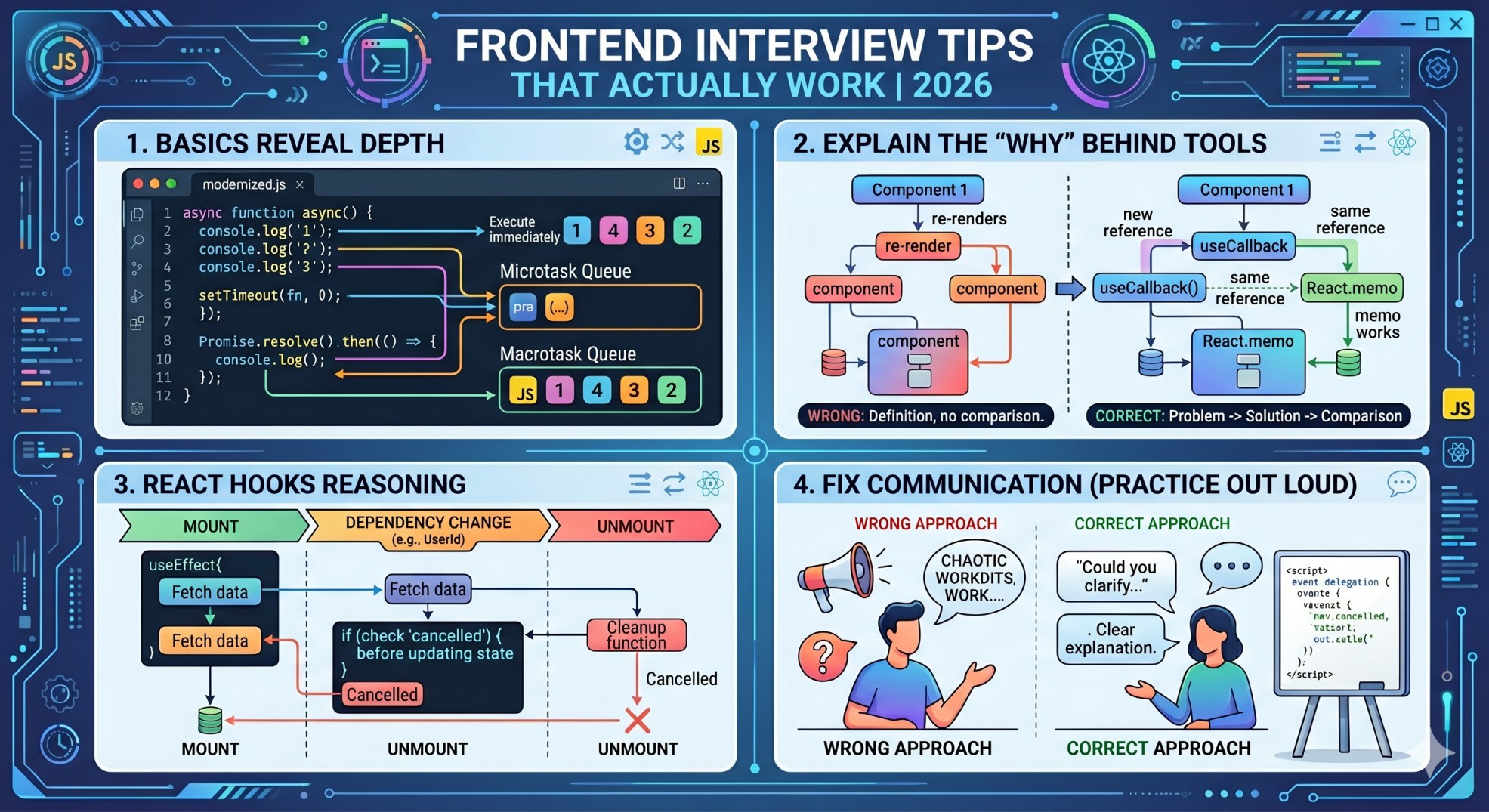
Frontend Interview Tip 1: Basics Are the Real Test
Most developers prepare for advanced topics. Complex React patterns, system design at scale, advanced TypeScript generics. Product company interviewers almost always start with basics.
This is not because they want junior engineers. It is because basics reveal how deeply you actually understand your tools.
The pattern across every MNC interview I gave was consistent. Interviewers start with a basic concept. Your answer determines how deep the conversation goes. Answer well, and they go deeper. Struggle, and they move on. The interview never reaches the advanced material you prepared.
javascript
// Wrong — what most devs can explain
// "A closure is when inner function accesses outer variable"
function outer() {
  let count = 0;
  return function inner() {
    count++;
    return count;
  };
}
javascript
// Correct — what interviewers actually want to hear
// Explain WHY it works, not just WHAT it is
function outer() {
  let count = 0;
  // inner() closes over count — it keeps a reference
  // to count's memory location, not just its value
  // Even after outer() finishes, count stays alive
  // because inner() still references it
  return function inner() {
    count++;
    return count;
  };
}

const counter = outer();
counter(); // 1 — count is still alive in memory
counter(); // 2 — same count, not reset
The difference is the reasoning chain. Not just what a closure is, but why count stays alive after outer() finishes executing. That level of explanation is what separates candidates who clear rounds from those who do not. This same depth of understanding is why React useEffect behaves unexpectedly - both trace back to how JavaScript manages memory and scope.
Frontend Interview Tip 2: Know the Why Behind Every Tool
The single most common interview question pattern at product companies is: "Why do you use X instead of Y?"
If you use useCallback, they ask why not just define the function inline. If you use Context, they ask why not Redux. If you use CSS Grid, they ask when you would use Flexbox instead. Every tool you mention becomes a "why not something else" question.
javascript
// Wrong answer pattern — most candidates do this
// Interviewer: "Why do you use useCallback here?"
// Candidate: "To memoize the function"
// This tells the interviewer nothing about understanding

function SearchBar({ onSearch }) {
  const handleInput = useCallback((e) => {
    onSearch(e.target.value);
  }, [onSearch]);

  return <input onChange={handleInput} />;
}
javascript
// Correct answer pattern — explain the problem it solves
// "Functions in JavaScript are recreated on every render.
//  Without useCallback, handleInput is a new function reference
//  on every render. If SearchBar passes handleInput to a
//  child wrapped in React.memo, that child re-renders every time
//  because it sees a new function reference even if the logic
//  is identical. useCallback keeps the same reference
//  across renders so memo actually works."

function SearchBar({ onSearch }) {
  // Same reference across renders = child memo works correctly
  const handleInput = useCallback((e) => {
    onSearch(e.target.value);
  }, [onSearch]);

  return <input onChange={handleInput} />;
}
Prepare every tool in your stack with this format: what problem existed before this tool, how this tool solves it, and what you would use if this tool did not exist. The MDN documentation on closures covers the exact mental model interviewers expect.
Frontend Interview Tip 3: Async JavaScript Is Always on the Test
Every frontend interview at a product company tests async JavaScript. Promises, async/await, the event loop. Not definitions - behavior under specific conditions.
javascript
// Wrong — what most developers say when asked about this output
console.log("1");
setTimeout(() => console.log("2"), 0);
Promise.resolve().then(() => console.log("3"));
console.log("4");

// Most candidates say: 1, 2, 3, 4
// Or: 1, 4, 2, 3
javascript
// Correct — actual output is 1, 4, 3, 2
// And you need to explain WHY

console.log("1"); // synchronous — runs immediately
setTimeout(() => console.log("2"), 0); // macrotask queue
Promise.resolve().then(() => console.log("3")); // microtask queue
console.log("4"); // synchronous — runs immediately

// Output: 1, 4, 3, 2
// Why: synchronous first, then microtasks (promises),
// then macrotasks (setTimeout) — even with 0ms delay
If you cannot explain why microtasks run before macrotasks, or why setTimeout(fn, 0) does not mean "run immediately," you will struggle in this section. Practice these execution order questions until the reasoning is automatic. Related: this is also why JavaScript promises behave unexpectedly in real apps - the same event loop rules apply.
Frontend Interview Tip 4: Fix Your Communication Before the Interview
This is the frontend interview tip nobody talks about. I failed interviews because of communication, not knowledge. I knew the answer. I could not put it in front of the interviewer clearly.
Three things cause this:
Thinking in one language, speaking in another. If you think in Hindi but interview in English, there is a real-time translation happening while you also explain a technical concept. The cognitive load is too high.
Starting to answer before fully understanding the question. Most candidates hear a keyword and start talking immediately. Product company interviewers often ask layered questions.
Nervousness creating blanks. You have explained this concept before. Under pressure it vanishes.
javascript
// Wrong interview approach
// Interviewer: "Tell me about event delegation"
// Candidate: [immediately starts talking about event listeners]
// Result: Misses the point, goes in wrong direction

// Correct interview approach
// Interviewer: "Tell me about event delegation"
// Candidate: "Just to confirm — are you asking about
//             the pattern of attaching one listener to
//             a parent instead of multiple listeners to
//             children, or about how event bubbling works
//             in general?"
// Result: Shows maturity, clarifies direction, buys thinking time

// Then explain with code:
document.getElementById("list").addEventListener("click", (e) => {
  // Check what was actually clicked inside the list
  if (e.target.tagName === "LI") {
    console.log("Clicked item:", e.target.textContent);
  }
  // One listener handles all LI clicks — past, present, future
});
The fix is to practice speaking out loud. Not reading about concepts. Not writing them down. Saying them out loud to yourself or someone else until the words come automatically. Spend 30 minutes per day for two weeks doing this and your communication in interviews will change completely.
Frontend Interview Tip 5: React Hooks Need Reasoning Not Definitions
React hooks come up in every frontend interview. useState, useEffect, useCallback, useMemo, useRef. Interviewers do not want definitions. They give you a scenario and ask which hook to use and why.
javascript
// Wrong - candidate defines hooks but cannot apply them
// Interviewer: "You have a component that fetches user data
//               when userId changes. How do you handle this?"
// Candidate: "I would use useEffect and useState"
// Interviewer: "What goes in the dependency array?"
// Candidate: "userId"
// Interviewer: "What if the component unmounts mid-fetch?"
// Candidate: [silence]
javascript
// Correct - candidate shows the full reasoning
function UserProfile({ userId }) {
  const [user, setUser] = useState(null);

  useEffect(() => {
    let cancelled = false; // handle unmount mid-fetch

    async function fetchUser() {
      const data = await fetch(`/api/users/${userId}`).then(r => r.json());
      if (!cancelled) setUser(data); // only update if still mounted
    }

    fetchUser();

    return () => {
      cancelled = true; // cleanup on unmount or userId change
    };
  }, [userId]); // re-fetch when userId changes

  return <div>{user?.name}</div>;
}
The candidate who writes this code and explains why cancelled exists, why it is in the dependency array, and what happens without cleanup - that candidate clears the round. Knowing this pattern deeply also prevents the React state update issues that cause bugs in production.
Key Takeaway
Frontend interview tips work only when you practice them, not just read them. Here is what actually matters:
Interviewers start with basics - your depth there determines where the conversation goes
Every tool needs three answers: what it is, why it exists, why not something else
Async JavaScript behavior - not definitions, actual execution order
Communication is a separate skill - practice speaking out loud before the interview
React hooks need scenario-based reasoning, not API knowledge
Ask clarifying questions before answering - it shows maturity
The developers who consistently clear frontend interviews at product companies are not the most knowledgeable. They are the ones who know their fundamentals cold and can explain their reasoning clearly under pressure. That combination is rarer than most developers think.
FAQs
What do product companies actually test in frontend interviews? Product companies test fundamentals deeply rather than advanced topics broadly. JavaScript closures, promises, async/await, React hooks, CSS layout, and browser rendering come up in almost every first round. Interviewers start basic and go deeper based on how you answer - solid fundamentals naturally lead to advanced conversations.
How do I improve my communication in frontend interviews? Practice explaining concepts out loud in English before your interview - not reading, not writing, actually speaking. Spend 30 minutes daily for two weeks on this alone. Also practice asking clarifying questions before answering. Saying "just to confirm, are you asking about X in the context of Y?" shows maturity and gives you thinking time.
What is the most important frontend interview tip for product companies? Know the why behind every tool you use. Not just what it does - what problem existed before it, how it solves that problem, and what you would use if it did not exist. Interviewers ask "why not X?" for every tool you mention. If you cannot answer that, the interview stalls.
How long should I prepare for a frontend interview at a product company? Four to six weeks of focused preparation is enough. Two weeks on JavaScript fundamentals - closures, promises, event loop, scope. One week on React hooks with real scenario practice. One week on CSS layout and browser basics. The last two weeks should be mostly speaking practice - explaining everything out loud until it is automatic.
Why do developers fail frontend interviews despite knowing the answers? Usually communication, not knowledge. Thinking in one language and speaking in another creates cognitive overload. Starting to answer before fully understanding the question leads to wrong directions. Nervousness creates blanks on concepts you know well. The fix is speaking practice, not more studying.