
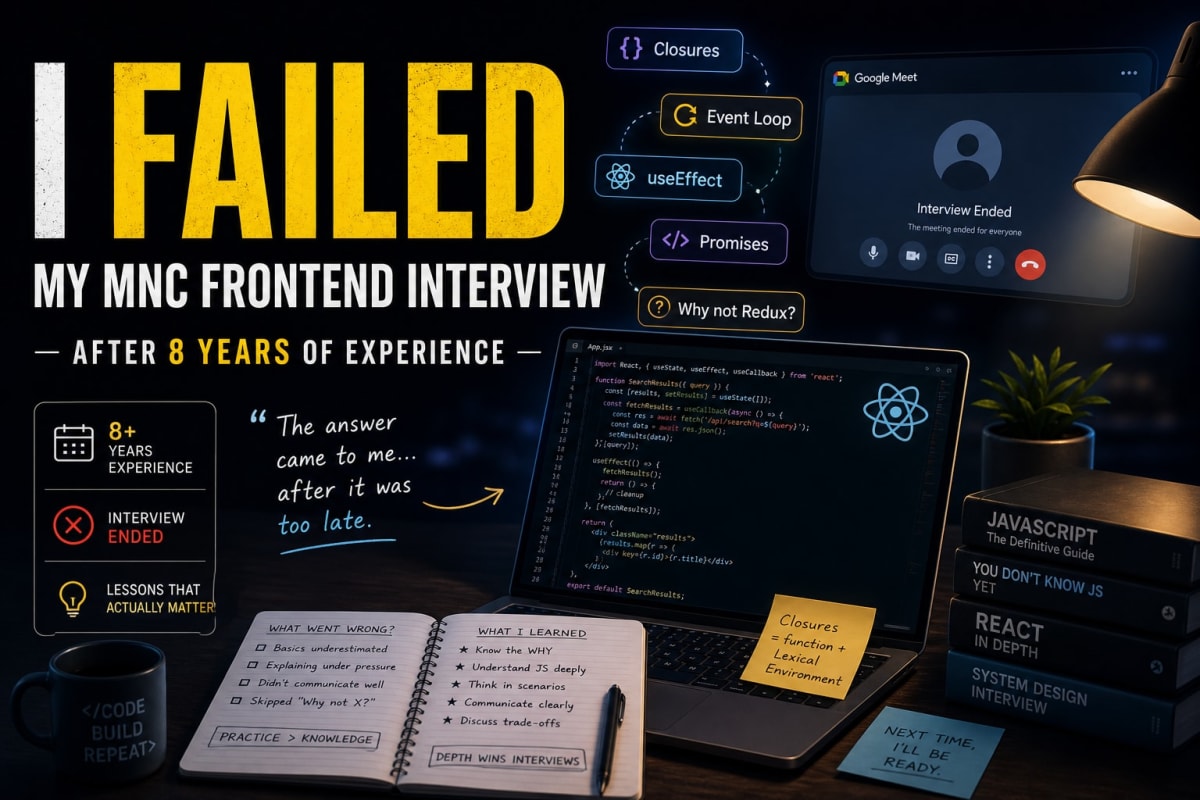
Frontend Interview Failed? What I Learned in 8 Years
Skilldham
Engineering deep-dives for developers who want real understanding.
Eight years of experience.
Real React projects. Production deployments. Bugs fixed at 2 AM. Team code reviews. All of it.
And then an interviewer asked me to explain closures on a Google Meet call.
Closures. Something I use every single day. Something I have explained to junior developers without even thinking about it. Something that lives inside every useCallback, every event handler, every setTimeout I have ever written.
Complete blank.
The interview ended. I closed my laptop. Sat back in my chair. And the entire answer came to me - perfectly, clearly, exactly as I would have explained it to a teammate.
That day I understood something that changed how I think about frontend interviews. Knowing something and explaining it under pressure are two completely different skills. And most developers fail interviews not because they lack knowledge, but because nobody taught them the difference.
Here are the five things I learned from that failure that actually matter in frontend interviews at product companies.
Why Basics Trip Up Senior Developers in Frontend Interviews
Before the tips, the myth needs breaking.
Most developers preparing for interviews think the problem is not knowing enough. So they go deeper into advanced React patterns, micro-frontend architecture, complex TypeScript generics. They spend weeks on things that almost never come up in first rounds.
Product companies start with basics. Every time.
Not because they want junior engineers. Because basics reveal how deeply you actually understand your tools. Anyone can memorize a pattern. Very few developers can explain why it exists, what problem existed before it, and what breaks when you use it wrong.
The dangerous part is that basic questions feel simple. So candidates give simple answers. And the interview stops there.
A question about closures is not a test of whether you know what a closure is. It is a test of whether you understand JavaScript memory management well enough to explain why a variable survives after its outer function finishes executing. That is a completely different thing.
This gap between surface knowledge and real depth is where most frontend interviews are decided. The remaining tips are about closing that gap.
Frontend Interview Tip 1 - Know the Why Behind Every Concept
The most common feedback developers get after failing rounds is "good knowledge but answers lacked depth." This is what that actually means.
When an interviewer asks about closures, the weak answer is the definition.
javascript
// Wrong - just the definition
// "A closure is a function that can access variables
//  from its outer scope even after the outer function returns"

function createCounter() {
  let count = 0;
  return function () {
    count++;
    return count;
  };
}
The interviewer nods. Then asks: "Why does count not reset to zero every time you call the returned function?"
And silence.
javascript
// Correct - explanation with reasoning chain
function createCounter() {
  let count = 0;
  // The returned function holds a REFERENCE to count
  // not just its value - the actual memory location
  return function () {
    count++; // still accessing the same memory location
    return count;
  };
}

const counter = createCounter();
counter(); // 1
counter(); // 2 - count never reset because the memory is still alive

// Why? JavaScript's garbage collector sees that the returned
// function still holds a reference to count's memory location.
// So it keeps that memory alive even after createCounter() finishes.
// That is the closure - the function plus its memory context.
The interviewer does not want the definition. They want the reasoning chain. Why does the memory stay alive? What is actually happening in JavaScript's memory model? What would break if closures did not work this way?
For every concept you prepare, answer three questions out loud before your interview: what is it, why does it exist, and what breaks when you use it wrong. That third question is where depth lives.
For more on how this same reasoning applies to React - read our guide on why React useEffect runs twice and what it actually means.
Frontend Interview Tip 2 - Async JavaScript Behavior Not Just Syntax
Async JavaScript shows up in almost every frontend interview. Not as syntax questions. As behavior questions.
This exact question comes up constantly:
javascript
// What does this print?
console.log("1");
setTimeout(() => console.log("2"), 0);
Promise.resolve().then(() => console.log("3"));
console.log("4");
Most developers guess 1, 2, 3, 4 or 1, 4, 2, 3.
The correct answer is 1, 4, 3, 2.
javascript
// Correct mental model - execution order
console.log("1"); // synchronous - runs immediately

setTimeout(() => console.log("2"), 0);
// macrotask queue - runs LAST
// 0ms does not mean "now" - means "after everything else"

Promise.resolve().then(() => console.log("3"));
// microtask queue - runs after synchronous, before macrotasks

console.log("4"); // synchronous - runs immediately

// Output: 1 → 4 → 3 → 2
// Order: synchronous first, then microtasks, then macrotasks
But the answer alone is not enough. The interviewer wants to know if you understand why. Synchronous code runs first. Then microtasks - Promises, queueMicrotask. Then macrotasks - setTimeout, setInterval, even with zero milliseconds.
This is not just an interview question. This is the reason loaders disappear at weird times in production. This is the reason state updates feel delayed. This is the reason API responses arrive in unexpected order under slow networks. The event loop is behind all of it.
Practice execution order questions until you can trace any combination of synchronous code, Promises, and setTimeout without hesitation. This is covered in detail in our post on why JavaScript promises behave unexpectedly in real apps.
Frontend Interview Tip 3 - React Hooks Need Scenarios Not Definitions
Interviewers do not ask you to define useState or useEffect. They give you a real scenario and ask what you would do.
The scenario that catches most candidates goes like this: fetch user data when userId changes, and make sure the fetch is cancelled if the component unmounts before it completes.
javascript
// Wrong - what most candidates write and stop at
function UserProfile({ userId }) {
  const [user, setUser] = useState(null);

  useEffect(() => {
    fetch(`/api/users/${userId}`)
      .then((r) => r.json())
      .then(setUser);
  }, [userId]);

  return <div>{user?.name}</div>;
}

// Interviewer: "What happens if the component unmounts
//               while the fetch is still running?"
// Candidate: [silence]
javascript
// Correct - production thinking
function UserProfile({ userId }) {
  const [user, setUser] = useState(null);

  useEffect(() => {
    let cancelled = false;

    async function loadUser() {
      const data = await fetch(`/api/users/${userId}`)
        .then((r) => r.json());

      // Only update state if component is still mounted
      if (!cancelled) setUser(data);
    }

    loadUser();

    // Cleanup runs when component unmounts OR userId changes
    return () => {
      cancelled = true;
    };
  }, [userId]);

  if (!user) return <div>Loading...</div>;
  return <div>{user.name}</div>;
}
The candidate who writes the cleanup and explains why the cancelled flag exists is showing production-level thinking. They are not just writing code that works in a demo. They are thinking about race conditions, unmounted components, and real network behavior.
That gap between demo code and production code is exactly what senior roles require. The cleanup pattern here is the same reason React useEffect not working in production is such a common issue - missing cleanup causes memory leaks and state update errors that only appear under real conditions.
Frontend Interview Tip 4 - Communication Is a Skill You Train Separately
This was my personal failure point. And it is more common than most developers admit.
The answer was in my head. The words did not come out right. I knew what I wanted to say and could not say it under pressure.
Three things cause this.
Thinking in one language and speaking in another. If you naturally think in Hindi but your interview is in English, there is a real-time translation happening simultaneously with a technical explanation. The cognitive load is genuinely too high for most people. The only fix is making English explanation automatic through repetition.
Starting to answer before fully understanding the question. Product company interviewers often ask layered questions. You hear a keyword, start talking, and realize halfway through that you went in the wrong direction. By then it is hard to recover.
Nervousness creating blanks on familiar concepts. The concept you have explained a hundred times in normal conversation suddenly disappears under interview pressure.
The fix for all three is the same. Practice speaking out loud. Not reading. Not writing notes. Actually speaking, explaining, reasoning out loud.
Spend thirty minutes every day before your interview doing this. Explain closures to yourself. Explain the event loop out loud. Explain useCallback to a wall if you have to. The goal is making the explanation automatic so nervousness cannot erase it.
One more technique that works immediately. Before answering, say this: "Just to confirm - are you asking about X in the context of Y?" This one sentence buys you thinking time, shows the interviewer that you think before you speak, and prevents going in the wrong direction. Interviewers read this as maturity, not hesitation.
Frontend Interview Tip 5 - Prepare for Why Not X for Every Tool
Product companies have a favorite follow-up question. You mention any tool or approach and they ask: why not something else?
You used Context. Why not Redux? You used useCallback. Why not just an inline function? You used CSS Grid. When would you use Flexbox instead?
This is not a trick. They want to know if you made a choice or just used what you knew. Developers who can explain trade-offs are the ones who make good decisions in real codebases.
javascript
// Weak answer to "Why useCallback here?"
// "To memoize the function" - tells the interviewer nothing

// Strong answer
function SearchResults({ onSearch }) {
  // Without useCallback - new function reference every render
  // const handleInput = (e) => onSearch(e.target.value);

  // With useCallback - same reference across renders
  const handleInput = useCallback(
    (e) => {
      onSearch(e.target.value);
    },
    [onSearch]
  );

  return <input onChange={handleInput} />;
}

// Why it matters:
// Functions in JavaScript are recreated on every render.
// A new reference on every render means child components
// wrapped in React.memo re-render unnecessarily.
// useCallback keeps the same reference so memo actually works.

// When NOT to use useCallback:
// - child component is not memoized (overhead without benefit)
// - dependencies change on every render (defeats the purpose)
// - simple components where re-render cost is negligible
Notice the last part. When NOT to use it. That is the answer that separates senior thinking from junior thinking. Junior developers know when a tool works. Senior developers know when it does not.
For every tool in your stack, prepare: what problem it solves, what you would use if it did not exist, and when it is the wrong choice. That three-part answer will handle almost any follow-up question an interviewer throws at you.
Key Takeaway
Frontend interview tips only help if you actually practice them, not just read them.
Basics are tested for depth, not definition. Every concept needs three answers: what, why, and what breaks without it
Async execution order is tested in every interview - synchronous first, microtasks second, macrotasks last
React hooks are tested through scenarios, not APIs - write code that handles unmounts and race conditions
Communication is trained through speaking out loud daily, not through more studying
Every tool you mention will get a "why not X" follow-up - know the trade-offs before the interview
The developers who consistently clear frontend interviews at product companies are not the most knowledgeable people in the room. They are the ones who know their fundamentals well enough to explain them clearly when it counts. Knowledge got you to the interview. Communication gets you the offer.
FAQs
Why do developers with years of experience fail frontend interviews? Most experienced developers fail because of communication, not knowledge. They know the concept but cannot explain the reasoning chain under pressure. Product companies test depth, not familiarity. Explaining why something works is a separate skill from knowing that it works, and it only comes from practicing explanation out loud before interviews.
What do product companies actually ask in frontend interviews? Product company frontend interviews almost always start with JavaScript fundamentals - closures, promises, async/await, event loop. Then move to React hooks with real scenarios. Then CSS layout and browser behavior. Advanced patterns come up later only if basics go well. Most candidates are eliminated in the basics round because their answers lack depth.
How do I improve communication in frontend developer interviews? Practice speaking out loud daily in English - not reading, not writing, actually speaking. Explain one concept per day to yourself for five minutes. Ask clarifying questions before answering - "just to confirm, are you asking about X in the context of Y?" gives you thinking time and shows maturity. Make English explanation automatic so nervousness cannot erase it.
How long should I prepare for a frontend interview at an MNC? Four to six weeks of focused preparation is enough if you prepare correctly. Two weeks on JavaScript fundamentals - closures, promises, event loop, scope chain. One week on React hooks with scenario practice. One week on CSS layout and browser basics. The last two weeks should be mostly speaking practice - explaining everything out loud until it feels automatic under pressure.
What is the correct answer for setTimeout vs Promise execution order? Synchronous code runs first, then microtasks (Promises, queueMicrotask), then macrotasks (setTimeout, setInterval). This means setTimeout(fn, 0) does not mean "run immediately" - it means "run after all synchronous code and all Promises resolve." This order is determined by JavaScript's event loop and is consistent across all environments.
Why does the interviewer always ask "why not X" after every answer? Product companies want engineers who make deliberate decisions, not developers who use whatever they learned first. When you mention any tool or approach, they ask about alternatives to see if you understand trade-offs. The best answers include when to use the tool, when not to use it, and what you would use in its place. That three-part answer demonstrates senior-level thinking.
What is the biggest mistake developers make when preparing for frontend interviews? Studying advanced topics instead of going deep on basics. Most developers spend weeks on complex patterns that rarely appear in first rounds while their explanation of closures or the event loop remains shallow. Interviewers notice immediately and the interview stays shallow. Basic concepts explained with real depth will always clear more rounds than advanced concepts explained at surface level.