
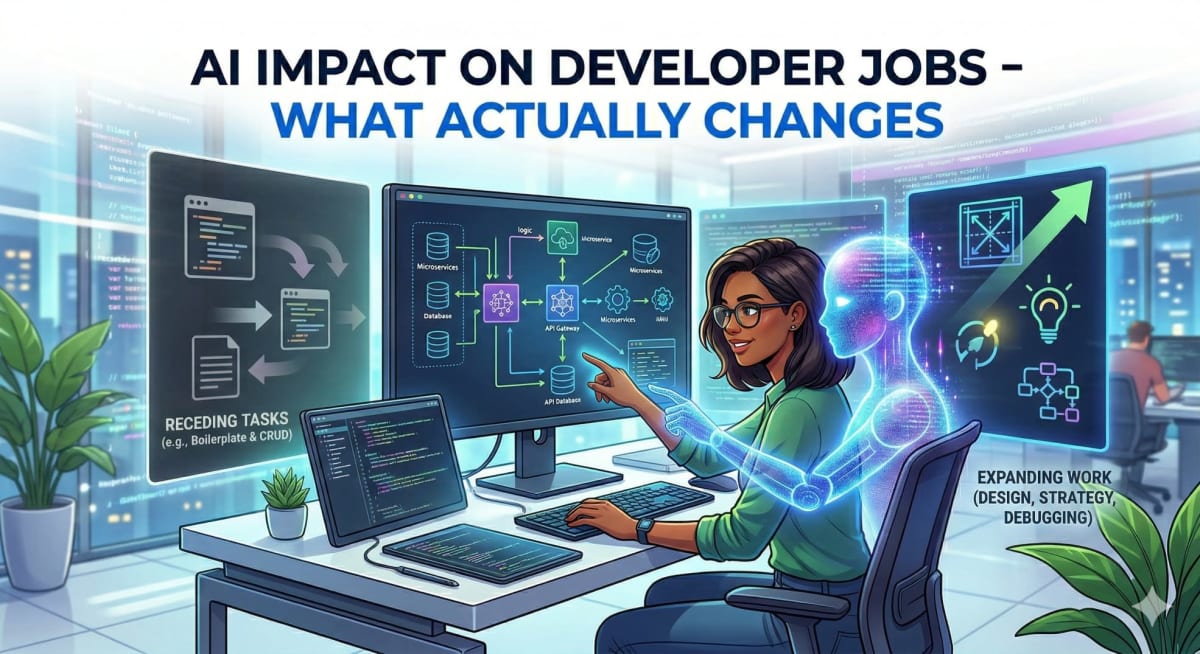
AI Impact on Developer Jobs - What Actually Changes
Skilldham
Engineering deep-dives for developers who want real understanding.
Every few months a new headline drops claiming developers will be replaced by AI within the year. LinkedIn fills up with panic. Twitter threads go viral. And somewhere in the middle of all the noise, actual developers are just trying to figure out what is real.
Here is the honest answer: AI is changing developer jobs. But not in the way most people think - and definitely not in the way the headlines want you to believe.
This is not a reassurance piece. It is a realistic breakdown of what is actually shifting, what is not, and what you need to do about it.
The ai impact on developer jobs is already visible - not in mass layoffs, but in how work is being done.
AI Is Not Replacing Developers - It Is Replacing Specific Tasks
This distinction matters more than anything else in this article.
AI tools like GitHub Copilot, Cursor, and Claude are genuinely good at specific things. Writing boilerplate code, generating CRUD endpoints, converting old class components to hooks, explaining unfamiliar codebases, writing unit tests for simple functions.
These are all real capabilities. And yes - these used to take developer time.
But here is what people miss: replacing tasks is not the same as replacing the person doing them.
A calculator replaced the task of manual arithmetic. It did not replace accountants - it made them faster and freed them to do higher-value work. The same shift is happening with AI and developers right now.
The developers who will struggle are the ones who only do these automatable tasks and nothing else. The developers who will thrive are the ones who move up the value chain.
What AI Cannot Do - And Will Not Do Anytime Soon
People dramatically overestimate what AI can currently do on its own. Let's be specific.
Architecture decisions are still human work. When you are building a new system, someone has to decide whether to use microservices or a monolith. Whether to put this logic in the frontend or the backend. How to handle auth, what the database schema should look like, how the system will behave under load. AI can give you options - but the judgment call requires understanding the business context, the team's capabilities, the timeline, and dozens of other factors that are not in the prompt.
Debugging complex production issues requires reasoning. The kind of bugs that actually matter - the ones that show up at 2am, the race conditions, the memory leaks, the intermittent failures under specific load patterns - these require a developer who can trace through a system mentally and form hypotheses. AI can help, but it cannot drive.
Business context is irreplaceable. A good developer is not just writing code - they are translating business requirements into technical decisions. They understand why a feature matters, what the edge cases mean for real users, what the tradeoffs are between shipping fast and building it right. This requires judgment that comes from experience and context, not pattern matching on training data.
Ownership and accountability have to live somewhere. No company is going to deploy to production without a human who understands what is being deployed and takes responsibility for it. That will not change.
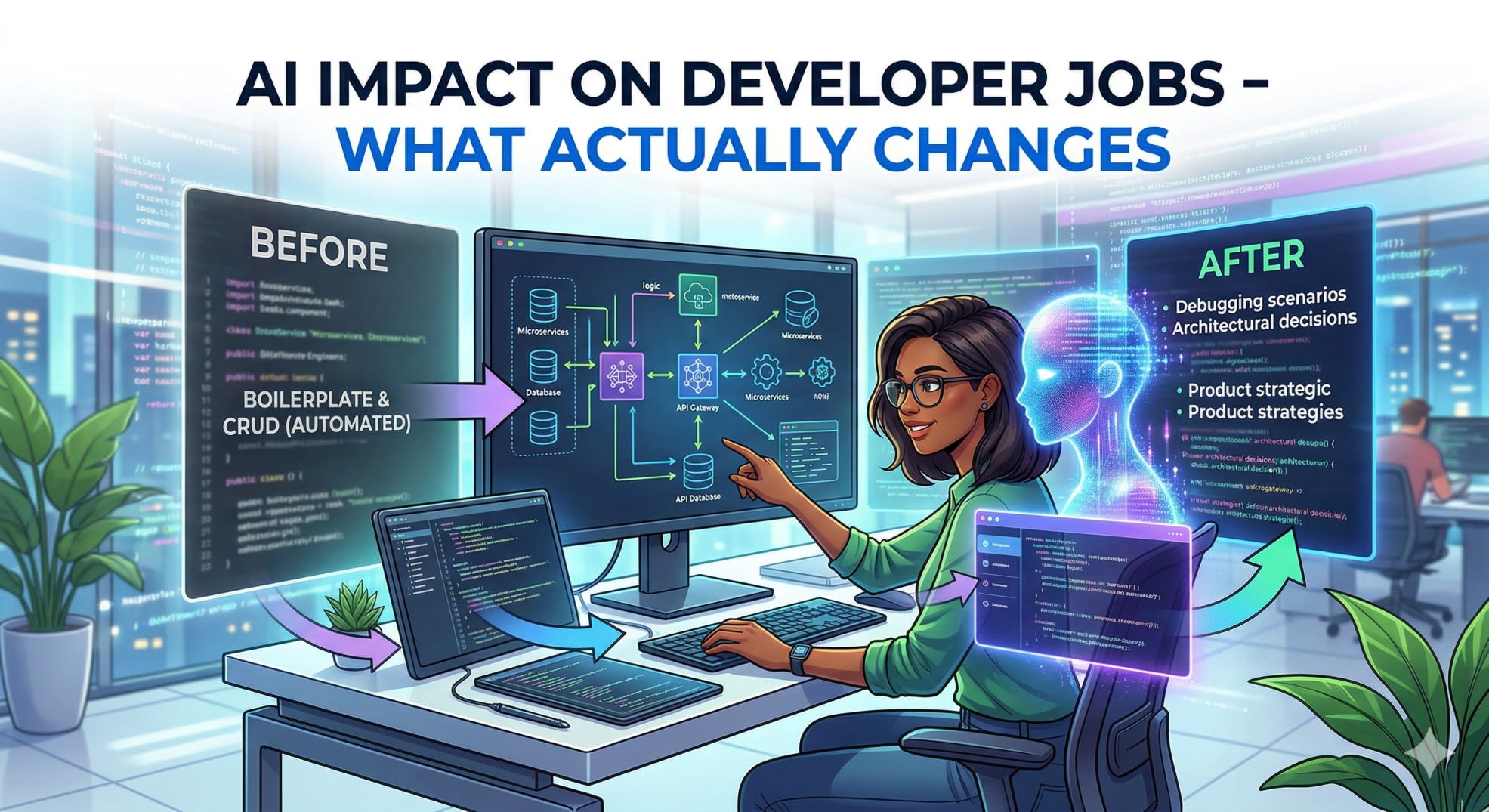
The Real Shift - What Changes in Your Day-to-Day
If you have been paying attention to how developers actually use AI tools today, the pattern is clear.
The best engineers use AI to compress the low-level work - the boilerplate, the syntax lookup, the first draft of a function. They spend their time on the parts that require judgment: designing the system, reviewing the output, making the tradeoffs, understanding the business problem.
If you write a component manually that takes two hours, AI can get you a working first draft in five minutes. That is not a threat - that is your two hours back. The question is what you do with those two hours.
The developers who answer that question well - by going deeper on architecture, by building more things, by understanding systems better - will be dramatically more valuable. The ones who just... wait for the next task? They will find their roles compressed.
For a practical example of this shift in action, check out our guide on why your API works in Postman but fails in the browser - the kind of debugging that still requires real understanding no matter how good AI gets.
New Roles That Are Actually Emerging
This is not speculation - these roles exist today and are growing.
Companies are hiring developers who can build AI-powered features into their products. Chatbots, document processing pipelines, semantic search, recommendation systems, copilot-style features inside SaaS products. All of these require engineers who understand both the product side and how to work with language models.
Beyond product work, there is a growing need for developers who can evaluate and validate AI output. As teams lean on AI generation, someone has to review what gets shipped. Code review for AI-generated code is a real skill - understanding what the AI got right, what it got wrong, and what the security or performance implications are.
The developers who understand AI systems at a technical level - not just as users but as builders - are going to have a significant advantage over the next five years. If you have not started building with the Anthropic or OpenAI APIs directly, that is worth exploring. Our guide on AI Agents for Developers covers the architecture side in detail.
What to Actually Focus On
The fundamentals are not going anywhere. JavaScript, TypeScript, data structures, system design, databases, networking - understanding how these things actually work is what lets you evaluate AI output, catch its mistakes, and make good decisions. AI cannot generate good architecture if you do not understand what good architecture looks like.
Beyond fundamentals, the highest-leverage thing most developers can do right now is start building. Build AI-powered features in your side projects. Use the APIs directly. Understand what retrieval-augmented generation is, what the limitations of context windows are, what makes a good prompt versus a bad one. This knowledge compounds quickly.
The React docs on hooks are still worth reading. System design fundamentals still matter. The difference is that now you have AI as a collaborator in the process - which makes you faster if you use it well, and no different if you do not.
Key Takeaway
AI is changing developer jobs by automating the low-level work and raising the floor on what developers are expected to handle. The ceiling for skilled developers is higher than it has ever been - not lower.
The realistic picture:
Boilerplate and repetitive tasks are being automated - this is already happening
Architecture, system design, and judgment are more valuable, not less
Developers who build AI-powered products have a clear advantage right now
Fundamentals matter more because they let you evaluate and direct AI output effectively
The developers at risk are the ones doing only automatable work with no movement up the value chain
AI is not coming for your job. It is coming for the parts of your job that were never the most interesting parts anyway.
FAQs
Will AI replace software developers completely? No - and the timeline claims you see online are not grounded in how AI actually works today. AI automates specific tasks, not the judgment, architecture, and business understanding that makes development valuable. The more realistic outcome is that AI raises the productivity floor and rewards developers who move up the value chain.
Which developer skills are safe from AI automation? System design, architecture decisions, debugging complex production issues, understanding business context, security and compliance thinking, and the ability to evaluate and direct AI output. These all require judgment and experience that current AI tools do not replicate.
Should I learn AI tools as a developer? Yes - not because your job depends on it immediately, but because the productivity difference between developers who use AI tools well and those who do not is already significant and growing. Start with GitHub Copilot or Cursor in your daily work, then explore building with language model APIs directly.
Will junior developer roles disappear because of AI? Junior-level tasks are being compressed, but junior roles are not disappearing - they are changing. The expectation for what a junior developer can produce is rising. Developers who build real projects, understand fundamentals deeply, and use AI as a productivity tool will still find strong opportunities.
What is the best career strategy for developers in the AI era? Focus on the things AI cannot do - architecture thinking, system design, business understanding, building real products. Use AI for everything it is good at to move faster. Build AI-powered features so you understand the space. And keep shipping - the developers who build consistently will always have an edge.