
Mongoose Populate TypeScript Error - Skip the Assertion Hack
Skilldham
Engineering deep-dives for developers who want real understanding.
Last updated: August 2026
TL;DR
Mongoose populate typescript error happens for one reason. populate() changes a field's value at runtime. It does not change the field's type. Your schema still says ObjectId. TypeScript blocks the fix because it never saw the populate() call. Do not fix this with an as cast. It hides the bug. It does not solve it. Use InferSchemaType. Add one manual override type. Add a runtime guard too. This covers single populate and array populate.
You define your schema. You call populate('author'). You try to read post.author.name.
TypeScript throws it back. Property 'name' does not exist on type 'ObjectId'.
You know populate worked. You logged the result. The name sits right there in the console.
So you do what most Stack Overflow answers say. You add as IUser. The red line goes away.
This is the mongoose populate typescript error. Nearly every team hits it the same way.
Three weeks later, a query skips the populate call. Nobody notices. The compiler stays silent. You told it to trust you.
Now users get emails with "undefined" in the subject line.
Here is what is really happening. Here is how to fix the type, not just the symptom.
Why Mongoose Populate Breaks TypeScript
A ref field stores an ObjectId in the database. That is its real shape in storage.
populate() swaps that ObjectId for the full document. But only at runtime.
TypeScript never sees your query. It only sees your interface. Your interface still says ObjectId.
So this fails to compile:
typescript
// Wrong: schema types author as ObjectId only, with no populated variant
interface IPost {
  title: string;
  author: Types.ObjectId;
}

const post = await Post.findById(id).populate("author");
console.log(post.author.name);
// Property 'name' does not exist on type 'ObjectId'
I hit this shipping the notifications feature on Munshi. The populate call was correct. The data was correct. Only the type was wrong.
This is not a bug in your code. Mongoose is being honest. It has a real limit in how it infers types.
The Type Assertion Fix - And Why It Is Dangerous
Most guides reach for the same fix. So do most AI answers.
typescript
// Wrong: silences the compiler, does not validate anything
const author = post.author as IUser;
console.log(author.name);
This compiles. It even works, as long as populate() actually ran.
But an as cast is a promise. It is not a check. TypeScript trusts you. It stops watching that variable.
Here is the failure mode. A second code path calls the same query with lean(). It skips populate:
typescript
// This still compiles, because you asserted the type earlier
const post = await Post.findById(id).lean();
const author = post.author as IUser;
console.log(author.name.toUpperCase());
// Runtime error: Cannot read properties of undefined (reading 'toUpperCase')
Nothing red appears in your editor. The build passes. The crash shows up later, in production, on a path nobody tested.
That gap is the real problem. Silenced is not the same as safe. That is why an as cast is the wrong fix here.
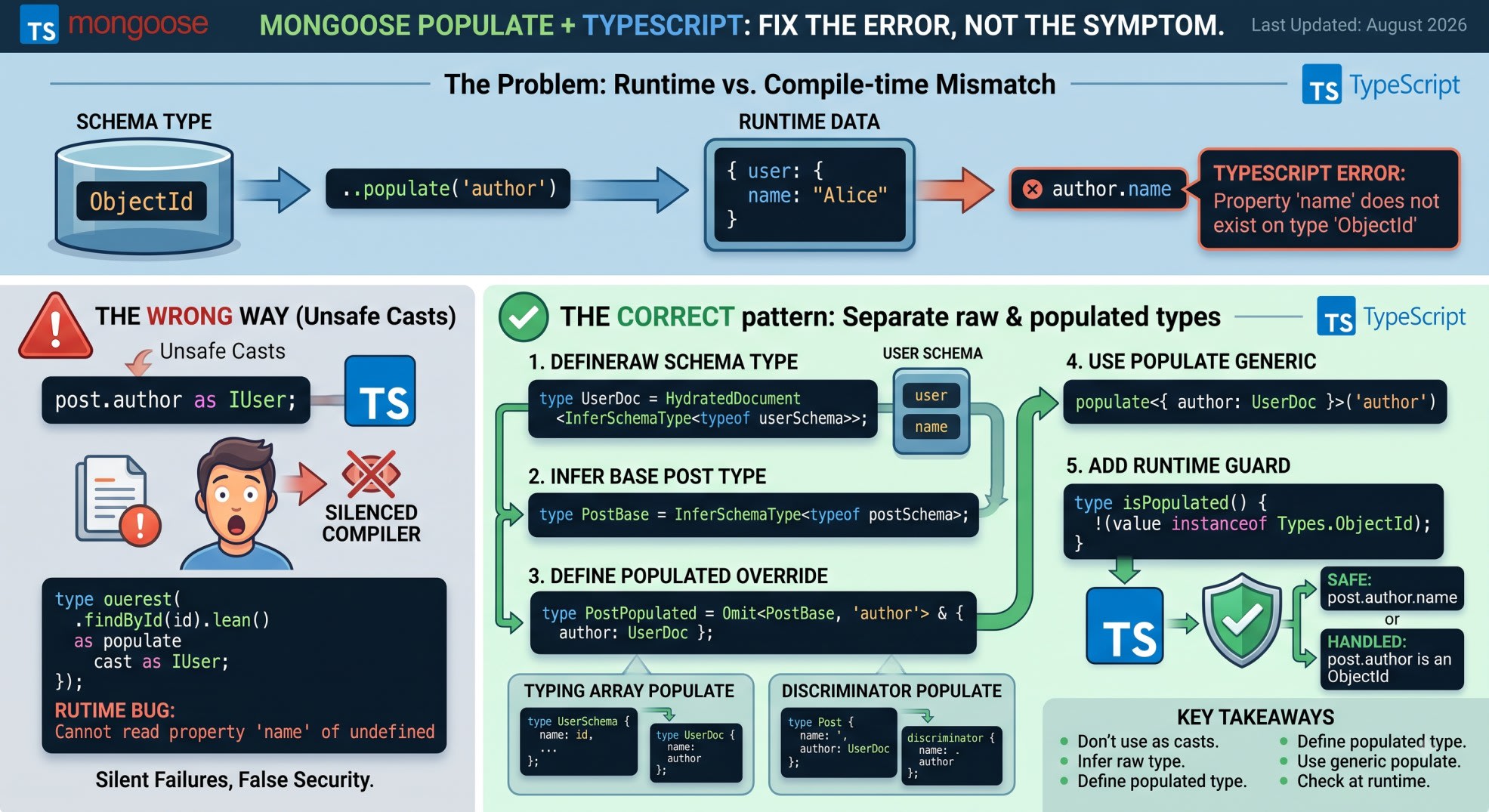
The Correct Pattern - InferSchemaType Plus a Populated Override
The fix keeps two types for one field. One type is the raw, stored shape. The other is the populated shape.
typescript
// Correct: base type from the schema, no populate assumptions
import { Schema, model, Types, HydratedDocument, InferSchemaType } from "mongoose";

const userSchema = new Schema({
  name: { type: String, required: true },
  email: { type: String, required: true },
});

type UserDoc = HydratedDocument<InferSchemaType<typeof userSchema>>;

const postSchema = new Schema({
  title: { type: String, required: true },
  author: { type: Schema.Types.ObjectId, ref: "User", required: true },
});

type PostBase = InferSchemaType<typeof postSchema>;

// Override author for the populated case only
type PostPopulated = Omit<PostBase, "author"> & {
  author: UserDoc;
};
InferSchemaType reads your schema. It builds the raw type for you. You do not write it twice.
Omit removes one field. The intersection adds it back with a new shape. Together they give you PostPopulated.
PostPopulated matches your real data. It matches the shape you get once populate() runs.
Your query function should return the type that matches what it did:
typescript
// Correct: the function signature tells the truth about populate
async function getPostWithAuthor(id: string): Promise<PostPopulated | null> {
  return Post.findById(id).populate<{ author: UserDoc }>("author").lean();
}
The generic on populate() names the field. It names the new shape too. No cast needed anywhere in the calling code.
Typing Array Populate Fields
Array refs need the same override. Just wrap it in an array.
typescript
// Wrong: comments stays typed as ObjectId[] after populate
interface IPost {
  comments: Types.ObjectId[];
}
typescript
// Correct: override the array field, not just a single field
type CommentDoc = HydratedDocument<InferSchemaType<typeof commentSchema>>;

type PostWithComments = Omit<PostBase, "comments"> & {
  comments: CommentDoc[];
};

async function getPostWithComments(id: string) {
  return Post.findById(id)
    .populate<{ comments: CommentDoc[] }>("comments")
    .lean<PostWithComments>();
}
The pattern does not change. You still swap one field's type. You just wrap it in an array.
The Discriminator Populate Edge Case
Most partial fixes break here. This is the case Stack Overflow rarely covers.
Say author can be a User. Or an Admin. A refPath field decides which one. populate() now returns one of two shapes.
typescript
// Wrong: PostPopulated assumes a single author shape
type PostPopulated = Omit<PostBase, "author"> & {
  author: UserDoc; // breaks the moment an Admin is populated instead
};
One override type cannot describe two shapes. You need a union instead. You also need one shared field to tell them apart at runtime.
typescript
// Correct: a discriminated union keyed on a shared field
type AuthorDoc = (UserDoc & { role: "user" }) | (AdminDoc & { role: "admin" });

type PostPopulated = Omit<PostBase, "author"> & {
  author: AuthorDoc;
};
On Paisa, one feed pulls from more than one source model. Discriminator populate shows up there often. The union type keeps every read honest about which shape it actually got.
A Runtime Type Guard You Can Trust
A type-safe field is not the same as a checked field. Types disappear at runtime. Add one small guard for the risky paths.
typescript
// Correct: a real runtime check, not an assumption
import { Types } from "mongoose";

function isPopulated<T>(value: Types.ObjectId | T): value is T {
  return !(value instanceof Types.ObjectId);
}

if (isPopulated(post.author)) {
  console.log(post.author.name);
} else {
  console.log("Author was not populated on this query.");
}
instanceof Types.ObjectId is a real check. It runs at runtime. It does not trust the query. It checks the actual value in front of it.
An as cast can never give you this. This code fails safely. It does not fail silently.
Key Takeaways
The mongoose populate typescript error happens because populate() changes runtime shape, not compile-time type.
An as cast silences the compiler. It does not check that populate actually ran.
InferSchemaType builds the raw schema type for you. You do not write it twice.
Override only the populated field with Omit and an intersection type.
Pass the populated field's type into populate() with a generic.
Array populate needs the same override, wrapped in an array type.
Discriminator populate needs a union type, not a single override.
A runtime guard using instanceof Types.ObjectId catches what types alone cannot.
Frequently Asked Questions
Does this pattern work with Mongoose 8?
Yes. HydratedDocument and InferSchemaType are part of Mongoose 8's typed API. So is the generic on populate(). This pattern targets Mongoose 8 and later.
Can I just use PopulatedDoc instead?
PopulatedDoc works for simple single-ref cases. It gets harder to read with array populate. It gets harder with discriminators too. This post builds the override type directly with Omit instead.
Why not just use as unknown as IUser?
Adding unknown does not add safety. It just removes one more compiler check. The runtime risk stays the same.
Does lean() change any of this?
Yes. lean() returns a plain object. It is not a Mongoose document. Use HydratedDocument only for full documents. Drop it from the override when a query ends in lean().
What happens if I forget to call populate() somewhere?
With an as cast, nothing warns you. The bug shows up at runtime. With this pattern, the return type still says PostPopulated. The mismatch gets caught the moment you read a populated field without a guard.
Do I need a type guard on every populate call?
Only on paths where populate might not run every time. A shared query function is a good example. It might run with or without populate.
Does this fix apply to virtuals as well as real refs?
Yes. A populated virtual has the same problem. The compile-time type comes from your schema. It does not come from your query. Apply the same Omit-and-override pattern to the virtual's field.
Is there a way to avoid writing the override type by hand?
Not fully, no. InferSchemaType removes the need to write the base type. The populated override is specific to your query. It still needs to be declared per query shape.
The Real Fix, Not the Quiet One
Mongoose cannot know your future queries from the schema alone. That is why this error keeps happening.
Fixing the type keeps your function signatures honest. They tell the truth about what your queries return.
The next time a populate path changes, the compiler catches it. Your users do not.
Timeout and buffering issues often show up around these same queries in production. The Mongoose buffering timed out guide covers the connection-level causes. Choosing between Mongoose and a typed SQL ORM for a new service? The Prisma and NeonDB driver adapter setup post covers the same pattern. It's the Prisma-side version of this fix.
For the official reference on how populate resolves refs, see the Mongoose populate documentation.