

Next.js App Shell Session Data: Is It Safe to Cache?
Skilldham
Engineering deep-dives for developers who want real understanding.
Last updated: August 2026
TL;DR
No. The App Shell is not shared across users.
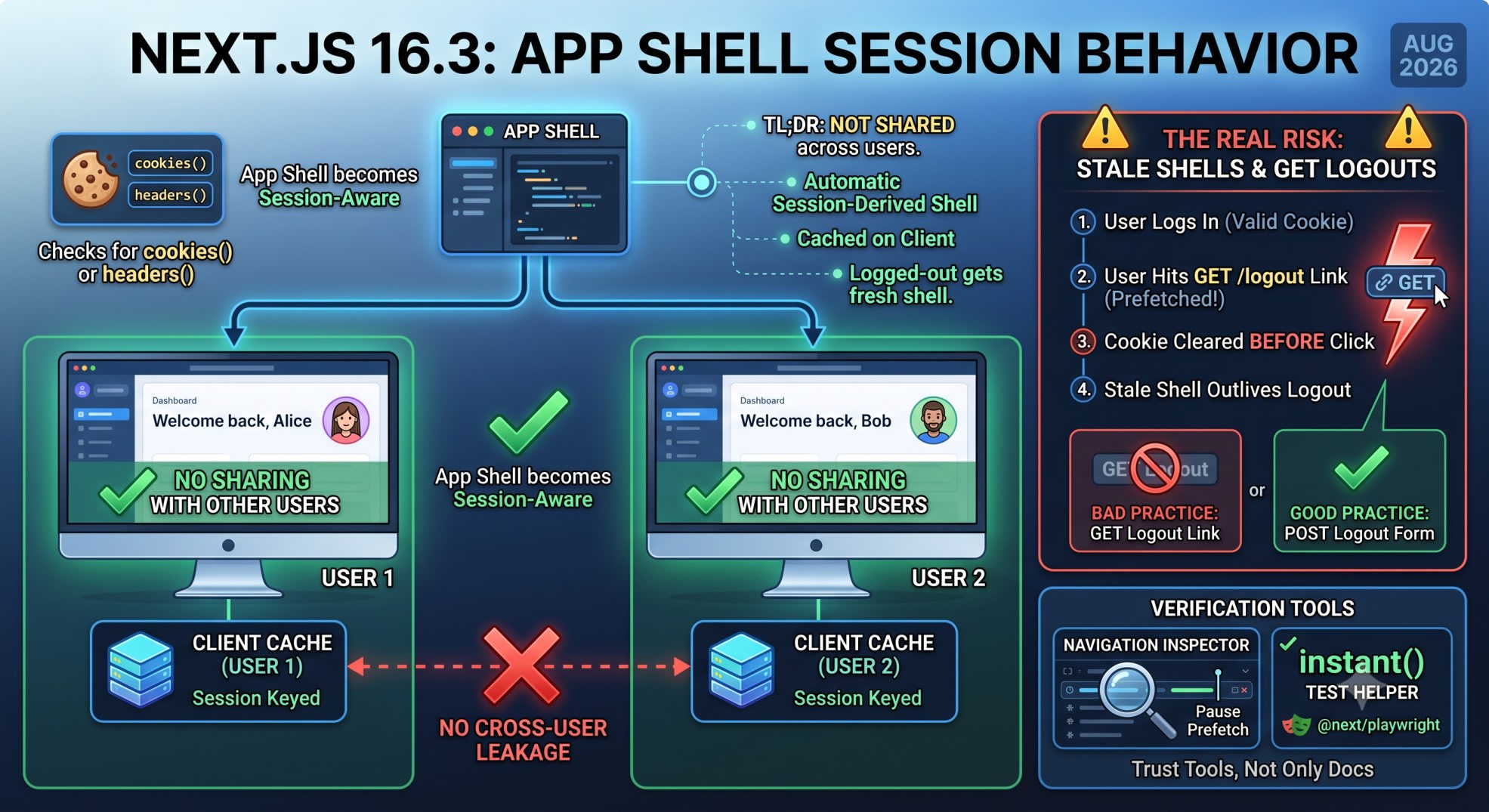
Next.js 16.3 checks if a route reads cookies() or headers(). If it does, that route gets its own session-aware shell. Next.js caches that shell on the client, one copy per browser.
The real risk here is not data leaking between users. The real risk is a stale shell that outlives a logout. It's also a link that clears a session before anyone even clicks it.
You ship a dashboard behind a login wall. You turn on partialPrefetching. Links feel instant now.
Then someone on your team asks a hard question. Does the prefetched shell leak one user's session into another user's browser?
You go check the docs. They mention that cookies() and headers() create a session-aware shell. That's the whole sentence.
No worked example. No answer for your exact dashboard route.
You assume the worst. Maybe the shell gets built once. Maybe it gets shared like a static file.
It doesn't work that way. But the reason matters. You should understand it before you ship real session data on a route.
Understanding the Next.js App Shell Session Behavior
With partialPrefetching: true, a Link no longer prefetches a whole page. It prefetches one reusable App Shell per route instead.
That shell holds the route's static output. Every visitor who never touches a cookie on that route gets the same shell.
The moment a route calls cookies() or headers(), that changes. Next.js sees the dependency. It treats the shell as session-derived from then on.
This next.js app shell session behavior is not a bug. It is the documented default the instant partialPrefetching is on.
A Next.js maintainer confirmed this directly. A developer asked about it in the 16.3 preview feedback thread.
The maintainer's answer was short: cookies count as session data. Session data is allowed inside the prefetched App Shell by design.
A docs update followed soon after to make this clearer.
A Real Example: A Dashboard That Reads cookies()
Here's a realistic dashboard page. It reads a session cookie to render a name.
tsx
// app/dashboard/page.tsx
import { cookies } from 'next/headers';
import { RecentActivity } from './recent-activity';

export default async function DashboardPage() {
  const cookieStore = await cookies();
  const userName = cookieStore.get('user_name')?.value ?? 'there';

  return (
    <main>
      <h1>Welcome back, {userName}</h1>
      <RecentActivity />
    </main>
  );
}
Because this page calls cookies(), Next.js marks /dashboard as session-dependent. The App Shell for this route now includes that personalized greeting.
Now compare that to a marketing page. It has no cookies() call anywhere in its tree.
tsx
// app/pricing/page.tsx
export default function PricingPage() {
  return <PricingTable />;
}
/pricing has no session dependency. Its shell is plain static markup.
Every visitor's browser reuses the same cached shell. Nothing in it depends on who is looking.
The dashboard's shell works differently, in one specific way. It gets cached on the client.
It gets keyed to that one browser's session. No other browser shares it.
Why This Differs From use cache: private
It's easy to confuse this with use cache: private. That's a separate feature for a similar problem.
use cache: private is a directive. You add it inside one specific function. You use it when you want to cache per-user output with your own lifetime.
Reading cookies() inside a cached function only compiles with that directive present. Without it, the build fails.
App Shell session caching works differently. It's automatic.
It applies to the whole route. You don't add a directive anywhere.
The framework watches for cookies() or headers() above the first uncached boundary. It adjusts the shell for you, with no extra code.
If cookies() is erroring inside a use cache function on 16, that's the other mechanism. It has its own separate failure modes.
Those are worth reading up on directly. They are not the same bug as this one.
A cached value can also look right in a Server Action but never reach the UI. That's a different, related confusion.
If you've hit it, server action cache not updating covers it separately.
Safe Because of This: What's Fine to Ship
Three things make this genuinely safe for an auth-gated dashboard.
First, the shell lives in one browser's own client cache. Nothing writes it to a shared server cache. No other request can read it.
Second, a logged-out visitor has no session cookie. Next.js recomputes the shell for them from scratch. An anonymous visitor never sees a signed-in user's greeting.
Third, static content still shares one shell across every visitor. Only the cookie-dependent parts get session-scoped treatment. You don't pay a personalization cost for content that isn't personal.
This also means adding one cookie() call doesn't taint your whole app. It only changes the shell for that one route.
A sidebar with no cookie reads of its own keeps sharing its shell. That's true even next to a dashboard page that reads cookies() directly.
Risky If You Do This: The Logout Link Problem
Here's the part that deserves a precise answer. Not a hand-wave.
Back in 2024, a Next.js discussion described a real production incident. A Link pointed to /logout in a nav bar. Next.js prefetched it automatically.
That prefetch fired a GET request on page load. It fired before anyone clicked anything. It cleared the user's auth cookie instantly.
The root cause wasn't cookies specifically. It was a GET route that mutated state.
Combine that with a router that prefetches links by default. You get a broken login flow.
The fix from that thread still applies today. Never let a GET request clear a session. Use a POST-only route with a form instead of a link, for logout specifically.
Partial Prefetching in 16.3 makes this old lesson sharper, not weaker. Default links now prefetch more session-aware content than before. The App Shell is allowed to carry session data now, by design.
A cookie-clearing route wired up as a plain link is exactly the wrong shape here. It's the shape this feature was never meant to touch. It's also the exact shape that has broken real apps before.
What Changes When You Add Link prefetch
A common instinct kicks in when session behavior feels off. Reach for Link prefetch={true} and hope it fixes things.
That instinct points at the wrong problem here.
A Next.js core team member clarified this in the same feedback thread. By default, a Link already prefetches the most session-aware content it can. That means the shell, plus any cookie-derived UI inside it.
Adding prefetch={true} asks for something else entirely. It resolves URL-specific data ahead of time. Think params and searchParams, not cookies.
So prefetch={true} doesn't make session data more available. It makes per-link, per-URL data available sooner instead.
If your bug is stale session content, this prop is the wrong lever. If your bug is a param that isn't ready on click, it's the right one.
How to Verify This Yourself
Don't just take a blog post's word for it. Next.js 16.3 ships two tools built for exactly this question.
The first is the Navigation Inspector. It's a new devtool for 16.3.
It lets you pause a client-side navigation right at the App Shell. You can inspect exactly what loaded before the click, and what waited for it.
Open your dashboard route with the inspector running. Log in as one user, then check the paused shell.
Log out, refresh, and check it again. The greeting should differ. Nothing from the first session should carry into the second.
The second tool is the instant() test helper from @next/playwright. It lets you write a real regression test. That test asserts exactly what must render before any network work finishes.
Write one instant() test for your dashboard shell. Assert that no other user's name ever shows up in it.
Run that test in CI. Say a future refactor breaks the session boundary. The test catches it before a real user does.
Neither tool requires guesswork. Both exist for one reason. "Trust the docs" wasn't good enough for the team shipping this feature either.
No Playwright in your stack yet? You can still check this by hand. Open your dashboard in two browser profiles.
Sign in as a different user in each one. Load the dashboard in both. Watch the Network tab in each profile's DevTools.
Each profile should show its own prefetch request. Each shell should carry its own greeting.
If one profile ever shows the other user's name, stop. Treat that as a real bug, not a caching quirk.
Checklist Before You Ship an Auth-Gated Route
Confirm cacheComponents: true and partialPrefetching: true are both set. One without the other fails at config validation.
Search the whole route tree for cookies() and headers() calls. Check shared layouts too, not just the page.
Never wire a session-mutating action to a plain GET route. This applies most of all to logout.
Use a POST-only route with a form for logout. This is the same fix from the 2024 incident.
Don't reach for Link prefetch={true} to fix session staleness. It targets params and searchParams, not cookies.
Need explicit control over per-user cached output? Look at use cache: private instead. It's a different tool for a different job.
Add one instant() Playwright test per auth-gated route. Assert the session boundary holds under a refactor.
Key Takeaways
The next.js app shell session cache lives on the client. It's keyed per browser session. It's never shared across users.
Any route that reads cookies() or headers() gets an automatically session-aware App Shell. This is documented default behavior. It is not a bug.
The real danger isn't cross-user leakage. It's a GET route that mutates session state getting hit by an automatic prefetch. That's the same failure that broke logout flows back in 2024.
use cache: private is a different, opt-in mechanism for per-user caching. Don't confuse the two when debugging.
Link prefetch={true} resolves URL data like params and searchParams. It does not change how session data is handled.
Logged-out visitors always get a fresh shell. They carry no session cookie, so there's nothing stale to detect.
Use the Navigation Inspector and the instant() test helper to verify session boundaries yourself, instead of trusting a doc page alone.
FAQ
Does the App Shell leak one user's session data to another user?
No. The shell lives in one browser's client cache. It's keyed to that browser's session. No other user's request can read it.
Is the next.js app shell session behavior a bug?
No. A Next.js maintainer confirmed this directly in the 16.3 feedback thread. Cookies count as session data. Session data is allowed inside the prefetched App Shell by design.
Do I need use cache: private for this to work?
No. App Shell session detection is automatic once partialPrefetching is on. use cache: private is a separate directive for caching per-user output inside one specific function.
What happens to the cached shell after a user logs out?
Once the session cookie is gone, the next shell build has no cookie to read. Next.js builds a fresh, logged-out shell instead. The old signed-in shell never shows up for a different session.
Does Link prefetch fix session-related staleness?
No. It resolves URL data like params and searchParams ahead of navigation. It does not change what session data lives in the shell.
Should logout routes ever be a GET request?
No. A 2024 Next.js discussion documented a real production incident. A prefetched GET logout link cleared sessions before any click happened. Make logout POST-only instead.
Does this apply if I haven't enabled partialPrefetching?
No. This specific App Shell session behavior only applies once cacheComponents and partialPrefetching are both on. Without them, prefetching works the way it did before 16.3.
Will this become the default in a future Next.js version?
The Next.js team has said this will become a default. That's expected in a future major version. It's worth learning the mental model now, before that switch flips.
Conclusion
The App Shell isn't leaking anyone's session. It's caching it, per browser, exactly as documented once you read all six pages together.
The real danger was never new. It's the same lesson from 2024. Don't let a GET link mutate a session, prefetch or not.
Get that one rule right. Partial Prefetching just makes your auth-gated routes feel instant, safely.
Mid-migration to Cache Components? Two posts are worth reading next.
One covers the OOM build fix. The other covers the use cache: private cookie issue.